Sunday, 7 August 2016

24(ish) hours in the South West

It was a few weeks ago while driving home from an excellent day's birding in Hampshire and Wiltshire that Ed Stubbs and I hatched a plan for an extended day trip to Cornwall in August, primarily to take in some of the great seawatching on offer at Porthgwarra at this time of year. As weeks went by Ed put together a mouthwatering itinerary which saw us, along with friend and Surrey birding legend Robin Stride, aiming to catch up with a very tasty and more than a little ambitious selection of target species.

So it was that we set off from Surrey at around 3pm on Friday 5th, with a view to reaching the far end of the Cornish peninsula before sunset, ready to start bright and early at Porthgwarra the following morning. En route we discussed potentially getting in a bit of seawatching that evening or perhaps stopping at Black Hole Marsh to twitch the Least Sandpiper. Sadly the latter bird wasn't reported throughout the day but our spirits weren't dampened, even when we ran in to the inevitable holiday/Friday evening traffic around Stonehenge. Unfortunately my car had other ideas and started to splutter and lose power a few miles later, and after a few phonecalls we were being chaffeur-driven back to Surrey by recovery man Fred, my poor old Focus strapped on the back of the lorry. We weren't about to let that stop us though.
 I asked Robin what the plan was now, as the sun began to go down and we got further and further away from Cornwall. He replied "we're going to Cornwall." Legend. Back in Godalming we quickly loaded in to Robin's car and set off, by now in darkness, but at least the roads were far quieter. We made good time and were approaching Porthgwarra a little after 2.30am, almost twelve hours after we originally set off. Certainly not the quickest journey to Cornwall but at least we got there - thanks to Robin! We pulled up by the roadside to catch a couple of hours sleep (well some of us - sorry Ed!) and then it was on with the adventure.

Despite my dressing up for Arctic conditions - I've done more than enough seawatching to know it can be a hypothermia-inducing pastime even in summer - we parked up by the cafe in Porthgwarra to find it remarkably calm and warm. Visibility was good from the seawatching point and there were already half a dozen or so birders present when we arrived at around 6am. We'd barely sat down before the first shout went up: 'Balearic Shearwater, close in!'. One of at least seven we had during our three hour stint here, and the best views I've had to date of this species. Manxies were streaming past almost constantly, interspersed with four Sooty Shearwaters, also giving better views in the calm conditions than I'd had in Britain before. The relatively flat sea and good light also afforded us lovely views of at least twenty Storm Petrels which passed by during our visit, many powering on west but some lingering and feeding near the Runnel Stone and gathered fishing boats. Other highlights from what ended up being one of my most enjoyable seawatches included a summer plumage Great Northern Diver which flew overland behind us, a single Whimbrel, and two Chough - a UK lifer for Ed. 
 By 9am things had gone a bit quiet so, after a quick coffee and a pasty (when in Rome), we hit the road again, heading to Perranuthnoe hoping to catch up with the long-staying Hudsonian Whimbrel. On arrival we met a birder who said he'd just had it in the next cove then watched it fly off west into the next cove along. It was getting a bit wet and windy at this point and we had a few frustrating minutes scouring the rocky coastline with just a single Eurasian Whimbrel and twenty or so roosting Curlew to show for it. A slight change in position though revealed more Whimbrel hidden amongst the Curlew - one with strikingly bold headstripes... We deliberated for a short while and then the bird took flight revealing a complete absence of white on its back - bingo! 
No pictures of the Whimbrel unfortunately, but it was nice to see Rock Samphire and Restharrow along the coastal path.
 
 Our next target bird was the Dalmatian Pelican. If accepted as a wild bird this would be Robin's 500th UK bird so the pressure was on! Ed fed us reports from BirdGuides as we drove. Apparently it had flown west from Restronguet a short while ago so we had an idea to pre-empt it and went to check out Hayle Estuary, another of the bird's favourite haunts. There was no sign of it when we got there but it was nice to be back at a place I've enjoyed birding several times in the past and to add a few common species to the day list. Just as we were about to walk up the road from the Old Quay House pub to get a better view of the estuary another report came in - the Pelican was back at Restronguet! Restronguet Creek is a beautiful part of the country, and reminded me a lot of South Africa. 
 We had no idea exactly where we were looking though, aside from an island somewhere in the creek south-east of Devoran. After an extended session on foot without reward a local pointed us in the right direction and we drove a little way east along the creek where we found the Pelican sitting on an island, as promised. I've seen Great White Pelican in Africa but this bird really looked huge. Something like a giant swan with the head of a Spoonbill, and then that ludicrous yellow bill. It hardly moved for the whole hour or so we watched it, aside from the odd stretch, scratch and look around. 
 After a well-deserved celebratory pint in the local pub we bid Cornwall farewell and continued on our way with around six hours of daylight remaining and three target birds left to see. Robin knew a few spots along the River Dart which he said were good for Dipper and, sure enough, at the second attempt we enjoyed close views of one. Only a year tick for us all but always a lovely bird to see.

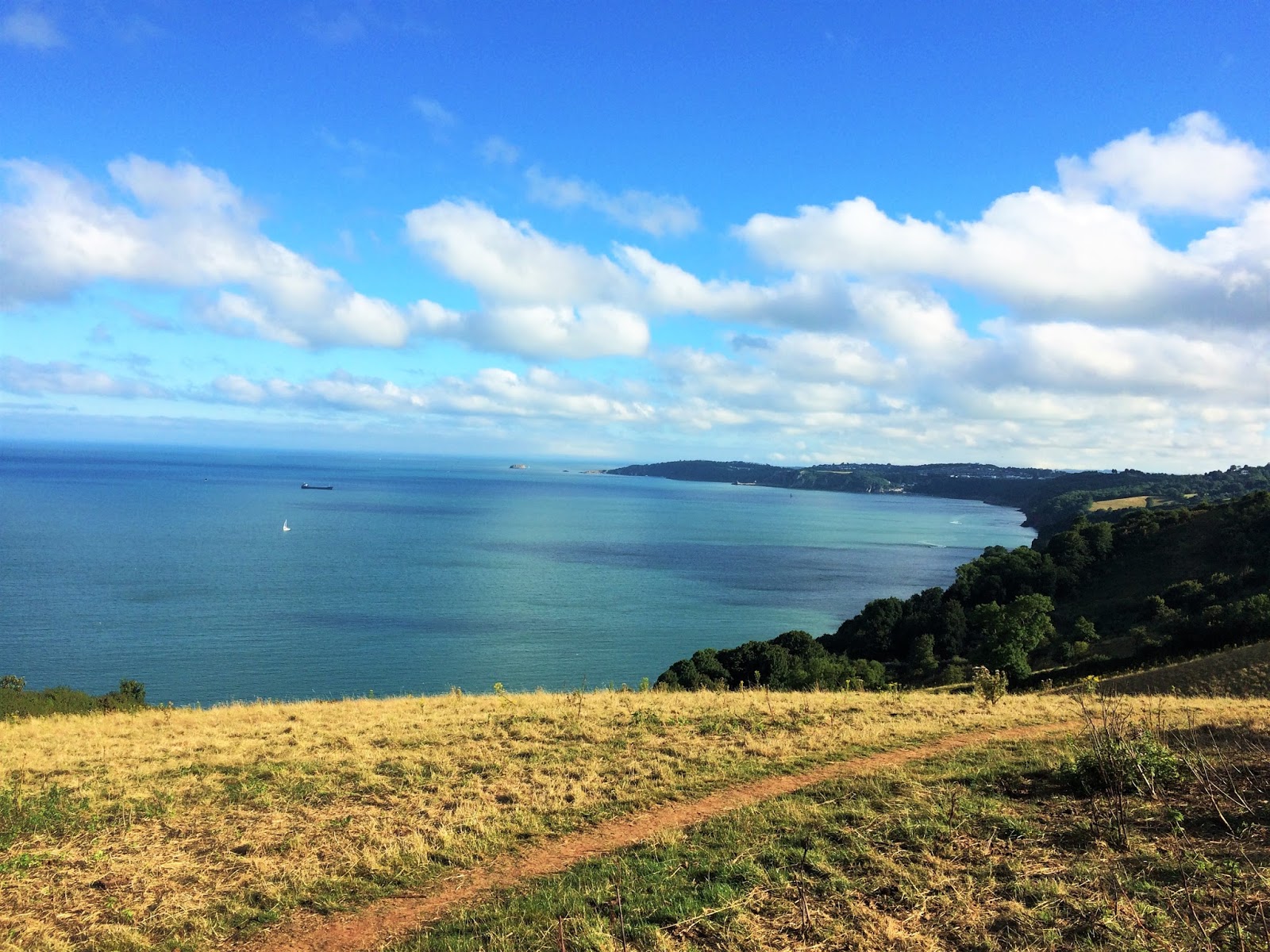
Next on the agenda was Labrador Bay for Cirl Bunting - a long-overdue lifer for me. I was blown away by the beauty of the place, the golden fields bathed in the late afternoon August sun against a backdrop of azure sky and sea. 
 We didn't have to venture far from the car park before a male Cirl Bunting flew over our heads and very obligingly perched in the hedge in front of us for a few seconds before flying deeper into the vegetation. Soon it flew back out, joined by a female, and both birds gave close views before disappearing into the sacrificial crop field. Before long they were back out again, both carrying food - clearly they have a second brood of hungry young to feed.

On the road again and just a couple of hours left to find our final target bird of the trip - the summer plumage Spotted Sandpiper that turned up at Sutton Bingham Reservoir near Yeovil during the week. After some very welcome directions from Sean Foote and Tim Farr via Twitter we found ourselves looking across at the fishing lodge area of the reservoir from the road that cuts through the northern section. The light was really fading now but by chance a small dark wader flew across my scope view and disappeared round the corner. We realised we had to get over by the fishing lodge, and after a few frantic minutes in the car we were there, now with just minutes of usable daylight left. A quick scan of all visible areas of sandy shoreline ensued before I spotted it (no pun intended) in the far corner. A stonking bird to end a stonking trip. As a Kingfisher piped its way across the reservoir and the last of the daylight waned away we climbed back into the car, exhausted but happy, and headed home for some very welcome sleep. Thanks to Ed and Robin for the company, the birds and the banter. Roll on the next trip!

Sunday, 3 July 2016

Shalford patch diary: Not all doom and gloom in June

It's hard to imagine a June less 'flaming' than the one we've just had, at least in the south of the country anyway. It seems like hardly a day passed without a deluge or two, and some days were total washouts. Nonetheless I've been persevering with the patch, still buoyed with renewed enthusiasm after the Brent Goose at the end of May, at a time when local birding can be an otherwise rather quiet and uneventful pastime. Two new species found their way on to the patch year list in June; one fairly predictable, albeit belated, the other rather less expected. Both occurred on consecutive days, also adding a bit of sparkle to what is usually one of the quietest months of the birding calendar.
Banded Demoiselle
An early morning visit in misty, drizzly conditions on the 17th produced the first of said patch ticks, with a Cuckoo (102) singing in the Broadford area as I walked down the Railway Line Walk to check out the marsh, which by the way really is looking in tip top condition now for the first returning waders (or at least it was before another load of heavy rain at the end of the month raised the water levels again!) Half an hour or so later as I made my way up to St Catherine's Lock I then found the Cuckoo singing in this area, slightly towards the north-east in fact, near Shalford Park. I haven't heard it again since.
Little Owl showing off its 'false face'
June patch tick number two came the very next morning, again after an early start which had produced little of note in the first hour or so, despite a scan of Broadford Marsh and a loop around the whole of the southern end of the patch. Heading north along the towpath towards St Catherine's, stopping frequently to scan the sky hoping to catch sight of the still elusive patch Hobby, at about 8.40 I picked up a bird heading strongly north just to the west over towards Loseley. My initial impression without bins was of a gull or a falcon as it powered fast and straight but as I got bins on it I immediately recognised the long decurved bill and gull-like wings and flight action of a Curlew (103). I tried to take a couple of pictures but typically had no luck - literally a needle in a haystack with a bird moving at pace in an otherwise empty sky!
Little Grebe with young, near St Catherine's Lock, 11th June
As you'd expect for this time of year the patch is now teeming with young birds, from Little Grebes and Mallards to Goldcrests and Starlings. Perhaps most surprising though was the very juvenile Stonechat I stumbled across on the towpath at St Catherine's Lock on the 18th. Given how young it was it would suggest it had fledged locally, which is odd as it's the first Stonechat I've seen around here since the start of March!
Juv Stonechat at St Catherine's Lock, 18th June
 Moving on to July and the weather was much more clement for my first patch visit of the month this morning. The sunshine was a treat in itself but I was also gifted another new patch bird mid-morning when the familiar laser cannon alarm calls of the local House Martins heralded the arrival of a passing Hobby (104). And about time too! Probably my favourite bird, I seem to have caught up with them everywhere this summer except on patch - until today. Sadly this one was only in view for a few seconds as it powered west, ducking and diving after hirundines as it went, before disappearing behind trees.

Fingers crossed this little flurry of midsummer patch ticks continues, otherwise roll on autumn! 
*

Wednesday, 29 June 2016

Knepp visit: a few days in the savanna of West Sussex

Just got back from a great few days staying on the Knepp Estate in West Sussex. Once used for intensive farming and grazing the 3500 acre estate has now been converted into one of the largest rewilding projects in lowland Europe thanks to the vision of Charlie Burrell, the owner of the estate and now chairman of Rewilding Britain. After finding the heavy weald clay tough-going when it came to producing crops, towards the end of the last century Charlie was looking for alternative ways to use the land and generate income for the estate. Having always had a passion for wildlife (he was nicknamed 'Bug' as a boy) a friend recommended he visit the Oostvaardersplassen project in the Netherlands, and it was this trip that inspired him to create his own rewilding project at Knepp.
Purple Emperor log mural at the Go-Down
Viper's-bugloss in the bank next to the car park
So it is that what were once arable crop fields are now teeming with brambles, hawthorn and wild roses. Hedgerows which were once flailed within an inch of their life are spreading and thickening, and roaming freely amongst all of this are the grazers, the drivers of ecology, as resident ecologist Penny Green refers to them. Exmoor ponies, English longhorn cattle, Tamworth pigs and Red and Fallow Deer (along with native Roe) wandering around a landscape largely devoid of fencing, just as their ancestral species would have done some five millennia ago. After just a decade and a half of this project the 'wildlands' of Knepp are already morphing into something incredible.

It really is hard to believe this was arable farmland fifteen years ago
 
In a way completely alien in comparison to most of the countryside of this part of the world, and yet also strangely familiar - some visitors to the estate have commented they are old enough to remember when more of the countryside looked like this. A time when Turtle Doves, Cuckoos and other farmland birds were thriving. And so far it seems these species are doing very well at Knepp, along with a whole host of other native wildlife. An estimated eleven pairs of Turtles Doves bred last year, while the estate also boasts 2% of the national breeding population of Nightingales since they returned in 2010 - the first time they'd been seen for fifty years. There are also excellent numbers of Barn Owls, Tawny Owls and Little Owls, not to mention Ravens, Hobbies and Spotted Flycatchers, to name a few. It's not just birds that are doing well at Knepp, as it is also famously home to the largest population of Purple Emperor butterflies in the UK, thanks to huge swathes of sallow which have colonised the Oak-lined damp fields which once harboured only monocrops.
Exmoor ponies
Barn Swallow
The obligatory friendly Robin in the camp kitchen

Toad near our tent on the first night, presumably well-fed on the
proliferation of slugs
I had heard so much about Knepp and wanted to visit for some time so was delighted when my girlfriend Kate booked the trip as a birthday present. We'd originally been scheduled to go on a Purple Emperor safari on the Sunday when we arrived, but were informed last week that due to the rubbish weather they had not emerged yet. No matter, as they offered us a place on a general safari tour on Monday instead, plus a reschedued Purple Emperor safari on 2nd July. The site tour was great and really helped us get some idea of the scale of the project here. Penny drove us around much of the southern block in an old six-wheel drive Austrian army vehicle and explained the aims of the project - basically what does happen if a large area of land is left largely unmanaged, aside from the actions of grazing animals? She explained how certain plants dominated but are now being replaced by other species; it must be fascinating to see a landscape evolve year on year like this. Although less than an hour from home, I can only equate some of the landscape at Knepp to the plains of Africa; this was especially the case when we stumbled across occasional herds of cattle, or piglets sleeping in the middle of the muddy tracks.
Longhorn cattle
Tamworth piglets
Hammer Pond - a haven for bats, wildfowl and invertebrates
Under reptile tins we found Grass Snakes and Slow-worms, as Garden Warblers sang in the swollen hedges. Penny also told us how thirteen of the eighteen native bat species are found here, and campsite manager Ryan Greaves kindly loaned us a bat detector which enabled us to have some close encounters with a few. We unfortunately didn't manage to track down a Turtle Dove but it's just great to know they're here and doing okay, for now at least. Perhaps we'll find one when we revisit at the weekend. I was lucky enough to chat to esteemed butterfly expert Matthew Oates a few times during our stay who did manage to find some Purple Emperors in the past couple of days, despite the changeable weather. In fact, the three he saw on Monday were the first recorded anywhere in the country this year. Despite exploring yesterday we unfortunately didn't find any Emperors but we did see good numbers of Marbled Whites, plus my first Purple Hairstreak and Small Skipper of the year.
Cinnabar moth - thriving at Knepp thanks to unchecked spread of
ragwort, their larval foodplant
Purple Hairstreak
I really cannot enthuse enough about how brilliant Knepp is, and how exciting it is to see such a massive swathe of countryside ' going back to nature'. I eagerly await our return visit on Saturday and the many more visits we will, I'm sure, be making after that to see how the place develops over time.
Tawny Owl

Tuesday, 7 June 2016

Shalford patch diary, late May/early June

After a flurry of migrants at Shalford in the first half of last month my patch list had been stuck on 100 since adding Common Tern on 18th May and I was approaching the beginning of June wondering which species would come next. Hobby perhaps? Or Cuckoo at last? There's still a few relatively common things I've not caught up with here. One of the joys of patch birding, of course, is the element of surprise. Sometimes the last thing you can think of turns up when you least expect it, and I think it's fair to say that stumbling across a Brent Goose at the end of May was about the last thing I was thinking of when I headed out for a stroll around the patch on the morning of the 29th.

Having done one of my usual routes, entering by the gate near Dagley Lane allotments and doing a little circuit of Broom Meadow (I promise I'll put a map on here one of these days!) my girlfriend and I then headed upstream along the navigation towards Broadford Bridge. There were lots of joggers, walkers and cyclists out and about as it was already mid-morning by this point and I wasn't expecting much in the way of patch gold as we headed up the steps to the Railway Line Walk.

The trees have leafed up really quickly along here and there's now only a couple of spots where one can easily view Broadford Marsh to the south. At the first such viewpoint I stopped to have a quick scan and waxed lyrical to Kate about the muddy edges looking absolutely perfect for a wader right now but 'there's just a lone Canada Goose out there today', I said pointing to a bird huddled up asleep. Wandering along to the next gap in the trees I stopped for another quick look and saw that the bird had lifted its head and that its head was in fact entirely black, with a thin white neck collar. It also suddenly seemed a lot smaller now I could see the whole bird. 'That's a Brent Goose!' I exclaimed to Kate who tried to exhibit at least a little of the same excitement as me.

The words had barely left my mouth before the bird took flight and disappeared from view. Scurrying down the slope towards the horse field we managed to pick it up again as it made a couple of circuits low over the field, its gleaming white tail feathers now very obvious along with the white bars across the top of its wings indicating it was born last year. It occasionally looked as though it might come down in the field but soon gained a little more height and flew off over the trees to the south-east. It may well have come down again somewhere locally but that was the last I saw of it. The most remarkable moment on my patch to date and all over in a matter of minutes.

Only the fourth record of Brent Goose in Surrey in 2016 and only my second ever record in the county after two that flew south over Leith Hill early one morning last October. I know there have been May records before and Dave Harris had one in June over QE2 Reservoir several years ago, but still a very unusual record I think it's fair to say. 


Branta-based excitement aside, it's been largely business as usual these past couple of weeks. The bulk of the passage migrants seem to have moved through now, certainly in terms of passerines anyway, and the breeding resident and migrant species are now getting on with nesting and rearing young. Indeed, many resident species' young have already fledged, with plenty of juvenile Pied Wagtails around the Broadford area now. 
A stroll down the Railway Line Walk at the moment is soundtracked by the distinctive squeaking of young Great Spotted Woodpeckers in the nest. Warbler numbers appear to have stabilised at a reasonable number after the usual glut of new arrivals in April and early May, and there now seem to be three Garden Warblers holding territory between St Catherine's Lock and Broadford, along with at least two Sedge Warblers. Reed Warblers have been a bit more hit and miss and the last one I had on patch was singing by the Riff Raff weir on the 29th, which may well have been a migrant still coming through.  

Swifts seem to still be arriving in reasonable numbers and just this morning there were a dozen or so feeding low over St Catherine's Lock with at least two each of Swallow, House Martin and Sand Martin. Also this morning the first Black-headed Gulls for a while were noted, with three adults flying high south-west. Kingfishers have been a more frequent sight this past week or so flying up and down the river, raising my suspicions they are breeding locally. On the raptor side of things the resident Kestrels and Buzzards have been busy bringing food to their nests. Still waiting for that patch Hobby though!

A few more recent shots:
Grey Wagtail at St Catherine's Lock

Song Thrush

Stock Doves having a scrap
Beautiful Demoiselle

Wednesday, 25 May 2016

Shalford patch diary, May so far.

May's been a busy old month for me, so whilst there's been no Lammergeier or Dalmatian Pelican, there's still a fair amount to report from the local patch in the past three weeks or so. The spring migrants have continued to flood in, with most of the expected species arriving more or less on cue although I've still not caught up with Cuckoo, Lesser Whitethroat and a few others, on the patch at least. The first Garden Warbler was bubbling away in Broom Meadow early on the 4th though and by the third week of the month there were at least four around the recording area.
On the 9th, meanwhile, the first Reed Warbler of the year was singing near St Catherine's Pool, with again further arrivals in subsequent days including one singing in a clump of bamboo by the Riff Raff weir on the 12th! On the evening of the 11th it was delightful to stumble across a Spotted Flycatcher living up to its name in trees along the navigation towards Broadford Bridge, I heard it again the following morning but have seen no sign of it since so suspect it may have moved on.
Spotted Flycatcher
 Other migrant species are seemingly still moving through, particularly Swifts which have increased greatly in the last week or so, although there are clearly still Swallows and House Martins coming through too. It's been wonderful to watch these aerial aces skimming low over the water at St Catherine's Lock. Sedge Warbler numbers still seem rather erratic, peaking so far on the 12th when there were at least six present.
Swift at St Catherine's Lock
Sedge Warbler in Bog Meadow
Two species I'd anticipated adding to the patch list without too much difficulty were Kingfisher and Common Tern so I was pleased to catch up with both recently. The latter were my 100th species at Shalford this year, with two flying south early on the 18th. Kingfishers meanwhile were heard near Riff Raff weir on the 14th and then seen in the same area again on the 23rd. In other news, I've noticed a slight increase in gulls flying over in the past week or so, with quite a few Herring and Lesser Black-backeds on the move, particularly on the 18th. Other recent flyovers of note have included single Little Egrets north and south-west on the 7th and 12th, respectively, a single Egyptian Goose north-east on the 18th and, most surprisingly, two Great Crested Grebes high south-west early on the 9th with a Mandarin in tow!
Chiffchaff
Great Spotted Woodpecker
There's been lots of evidence this month of birds breeding around the water meadows, with both Treecreeper and Starling seen carrying food to trees in Broom Meadow, Grey Wagtail young calling under Broadford Bridge, and a family group of Mistle Thrushes in the horse field near Broadford Marsh.

Away from the patch, on the 12th I made my first visit of 2016 to nearby Blackheath hoping for Nightjar and sure enough heard at least three churring males, along with two singing Cuckoos and a bonus singing Redstart - my first record for this site since I've lived locally.

Sunday, 1 May 2016

Shalford patch diary, weeks sixteen and seventeen


As every patch birder knows, we have a pastime that is at times very rewarding and at other times very frustrating, and sometimes it feels like there's an awful lot more of the latter - especially in my relatively bird-less neck of the woods! Still, after a little mid-month lull, Shalford Water Meadows has delivered a few goodies for me in the past couple of weeks and, despite the unseasonably chilly weather, I have been taking advantage of the longer days by making increasingly frequent early morning visits which have proved fruitful, and also meant I've been treated to some incredible scenes like this.
Warbler numbers seem to be growing every day, with a noticeable fall of Blackcaps on the 28th (at least eighteen noted during a 90 minute visit) and Whitethroats increasing to at least nineteen today. Chiffchaff numbers seem to have levelled off a bit although there were still at least ten singing males in the area between Broadford and St Catherine's this morning. As of 28th there was still a lone Willow Warbler singing in the Broadford area.
Chiffchaff - Richard Waters
Hirundines continue to move through in dribs and drabs, their efforts presumably hampered by the recent spate of northerlies. On the 19th it was nice to see three Sand Martins hawking low over St Catherine's Lock.
The first Swift (92) was seen on the 21st, followed by odd ones and twos this past week, but today saw the first more substantial arrivals, for me anyway, with at least a dozen through during my three hour morning visit - a group of nine were screaming over Dagley Lane as I left.
Whitethroat
Although we are now well into spring there have been some lingering reminders of winter with a few Redpolls and Siskins still kicking about, and a Little Egret which flew north on the 29th. Still, the summer migrants are arriving thick and fast now and, in addition to the aforementioned Swifts, I've added three new birds to the patch year list since my last blog post. The first came on the 21st as I approached the Horse Field along the Railway Line Walk to be greeted by a familiar call and one which I'd anticipated hearing in this exact location at some point - Yellow Wagtail (93)! Clearly I had flushed it as I approached the field and it flew off north-east over Broadford Marsh. This was followed by a stonking male on the 23rd which dropped into the field right in front of me as I was scanning the muddy ground for anything of note. Two flyover Yellow Wags were also recorded on the 24th and 1st May. One of my favourite birds (surely few other British birds can so embody summer in the sheer gaudiness of their plumage?); it's great to have caught up with so many so close to home.
Yellow Wagtail
Patch year ticks 94 and 95 arrived on the 26th in the form of Common Sandpiper and Sedge Warbler. I had perhaps expected the former to turn up at some point on Broadford Marsh but I definitely wasn't expecting to find one trotting along the towpath just north of Broadford Bridge. I kept my distance but after a while it flew to the other side of the Navigation where I was able to get a couple of photos before a passing cyclist flushed it and it flew off south. 


The Sedge Warbler, meanwhile, was singing away by St Catherine's Pool, where it was joined by a second bird on the 29th, and there were at least three around this morning.
Early morning on the 28th it was nice to see a female Redstart hopping back and forth from the fence to the ground in the north-west corner of Horse Field. My second patch record of this species this year but far more obliging than the one the other week.
Wildfowl numbers have dropped right down now with just a handful of late Teal lingering until the 19th, and a few resident Mallards and Mandarins still around. Early on the 29th a pair of Gadwall flew off south-west over St Catherine's Lock.
Looking east across Broadford Meadow
There has been much evidence of various species breeding in the area recently. I have noted a Grey Wagtail carrying food in the Broadford Bridge area on several occasions, while I've also seen a Sparrowhawk carrying prey across the river here a couple of times this past week. On the 24th, meanwhile, there was a newly-fledged Moorhen following one of its parents through one of the puddles along the Railway Line Walk, on the west side of Horse Field. I've also been monitoring a Buzzard nest in this area; it's remarkable to think not that long ago this species was still a rarity in this part of the world. 
The local Little Owls still appear to be around, although I have only seen one on occasion recently - hopefully this means they're now breeding and haven't been scared off by recent tree works along the railway line. 
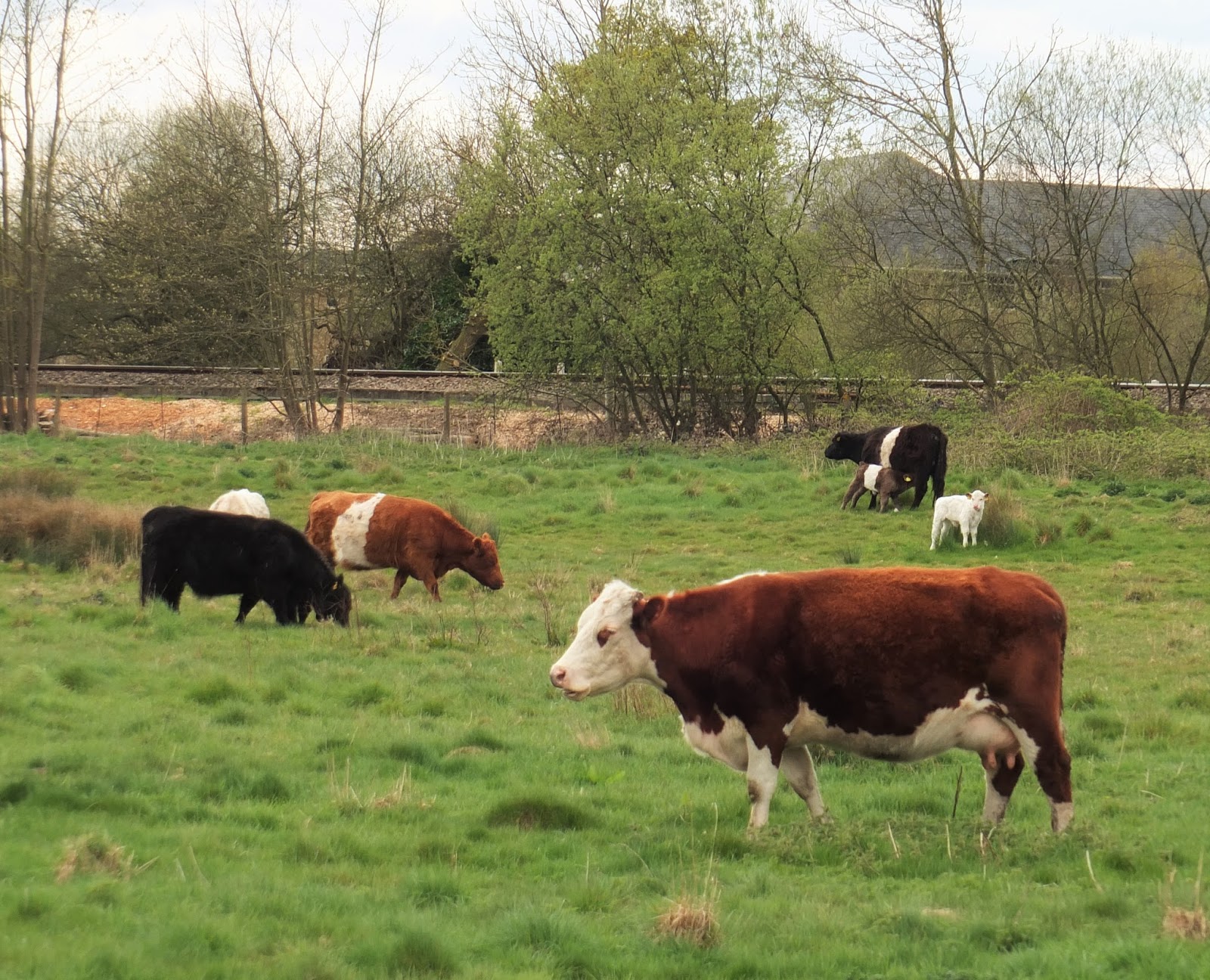
Another new addition to the patch recently have been the cows which appeared in St Catherine's Meadow and up in the Old Watermeadows near Guildford on the 24th. Cattle Egret anyone?
Cows!
Lapwings were recorded flying north-east twice last weekend - two on the 23rd and one on the 24th - only my second and third patch records of this species this year, surprisingly. 
Skylarks have been rather more evident recently, with one heard singing well west of Horse Field early on the 26th, 28th and 29th, and two which flew up from St Catherine's Meadow on 1st May. I know they breed up on the hills to the north-east and would imagine they're present at Loseley Park to the west, but suspect there is insufficient breeding habitat for them around the water meadows here. 
On 1st May I was surprised to stumble across a Firecrest along the Railway Line Walk - my first record of the species here for a number of weeks and seemingly an odd time for one to turn up, although Martin Kettell had one at Stoke Water Meadows just yesterday. A nice end to a good couple of weeks which has taken my Patchwork Challenge total to 95 species/101 points. I'm looking forward to seeing what May has in store!
Bullfinch
Pedunculate Oak in flower
Linnet

*