After being rushed to hospital on Friday evening to have my appendix removed I was told by the doctors to take a week to rest, but me being me I thought I'd turn my inability to get out birding on the patch or elsewhere into a little challenge and try for a few 'big days' from a comfy chair in the garden. Today was a particularly good day to do so, weather-wise, and I notched up a respectable 46 bird species.
The day got off to a good start as, no sooner had I got outside and set up my chair, the first garden Swallow for the year flew east, singing as it went.
A short while later an unmistakeable call alerted me to a Raven approaching from the direction of Blackheath. It then proceeded to soar over the garden for a couple of minutes along with the first Red Kite of the day before the two birds parted company and the Raven flew off high north. Only about my fifth garden record of this species.
Raven
Raven and Red Kite
The Red Kites kept coming throughout the day, with at least four birds involved, and two together chasing each other around low over the trees just after midday. Buzzards were up and about in good numbers too with a conservative count of six individuals seen during the day, including this strikingly pale bird.
Buzzard
Red Kite
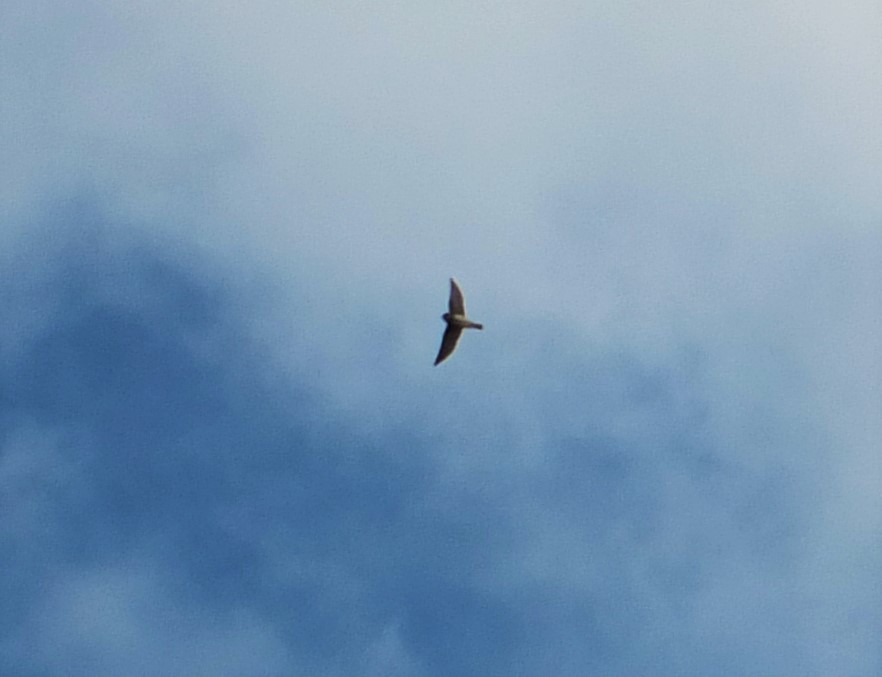
Singles of Kestrel and Sparrowhawk completed the raptor tally for the day - sadly there wasn't to be another Osprey after the one which flew west yesterday afternoon!
Aside from a few Redpolls and Meadow Pipits over, things went rather quiet on the skywatching front in the middle of the day - not least because we were enjoying the company of some visiting family members - but my first garden Blackcap of the year was nice to hear. We were also treated to an unexpected flypast from two Apache gunships and a Chinook!
Incoming!
Pied Wagtail
As the sun began to go down a hot air balloon appeared from the west, causing much panic amongst the water birds on the large private lake across the fields from our house. Mandarin and Coot were heard and at least four Shoveler were flushed up and circled for several minutes. Tick! Number 88 on the garden bird list since August 2014. We'll likely be moving house before the summer is over but I'm still hopeful of reaching 90 at this rate before we leave.
Shoveler (honest!)
There was plenty of non-bird excitement too, with my first Holly Blue and Orange-tip for the year of particular note amongst regular flypasts of Brimstone, Peacock, Small Tortoiseshell and Red Admiral. A Bee-fly made a brief appearance in the herb border at one point as did Common Carder Bee and Tree Bumblebee.
All in all, not a bad day considering I spent most of it sitting in one spot and, as the saying goes, tomorrow is another day!
I've got a bit out of the habit of doing my regular patch diary blog posts so am going to attempt to summarise the first seven or so weeks of 2017 in this one with as little waffle as possible! As I write this the patch year list stands on 75, just one behind this time last year and with several 'easy' species still missing, most notably Tawny Owl! One of the best things about patch watching though is it makes otherwise common species more rewarding when they do make an appearance, and it's been interesting to note several species that have been recorded earlier this year than last, and others that have been notable by their absence.
Greylag Goose is the third most commonly seen goose species on the patch and only ever seen in smallish numbers in 2016, so it was quite surprising to see approximately 70 flying NNE from Loseley direction towards Guildford on 28th January.Canada Geese are just as common as ever, with reasonable numbers (20-30) flying in to roost on St Catherine's Pool on all my evening visits recently. As was the case last year Egyptian Goose seems to be largely a flyover species here, so it was a bit of a surprise to see a pair in the dead tree in Broadford Meadows on 5th February, seemingly vying with a gang of Jackdaws over a nest box. Then this weekend a pair seem to have taken a liking to the St Catherine's Pool/Broom Meadow area, having been seen either on the water or in one of the Oaks here the past couple of days.
Egyptian Goose
Moving on to ducks, it took me until the end of March last year to record Wigeon on patch, with the 31st March birds remaining my only Shalford record until 7th January this year when I heard that familiar whistling call somewhere over Broom Meadow at first light, this then followed by two drakes on St Catherine's Pool during my WeBS count on 12th February. Shoveler, on the other hand, have been rather more elusive this winter than last, with the first ones not seen until 30th January. They've since been a fairly regular feature, peaking at 11+ on 12th February.
Wigeon and Shoveler flying off from St Catherine's Pool - great photo, I know
Another duck species that took me until spring last year to add to the patch list was Gadwall so it was nice to find a pair on Broadford Marsh on 12th February, again during my WeBS count. As was the case last winter, Teal is rivalled only by Mallard as the commonest duck on the patch. They tend to be quite scattered around the area though so it's hard to get an accurate count, but numbers of between 15 and 25 are regular, with a high count of 30+ on 15th January. Mandarin Ducks have been around in small numbers, peaking at at least 6 on 19th and 25th February - 4 flew from roost below St Catherine's Hill early on the latter date.
Gadwall
Teal
There's been at least one Little Grebe kicking about since the middle of January, mostly on the navigation downstream of St Catherine's Lock although more recently I've had one on St Catherine's Pool on a couple of occasions, where they bred last year. It was particularly unusual seeing one swimming amongst the trees in Mill Mead Meadow after the river burst its banks a few weeks back!
Little Grebe
On to gulls, and it's been the usual palette of Herring, Common and Black-headeds flying over recently, peaking at either end of the day, some of the latter occasionally coming down to check out the river or flying low over Dagley Lane towards the village green. Lesser Black-backeds are rather less common and I've had just one record of Great Black-backed Gull so far: one adult flying high south-west on 21st January.
Three species of wader have made it onto the year list so far, with Lapwing perhaps the most notable. In 2016 I only had a handful of records of this species, mostly in small numbers aside from a flock of 26 over in October. Again it was good to get them on the year list early this year with a flock of c.35 wheeling around towards Loseley on 21st January followed by around 30 flying over the same area on 5th February, then half a dozen north-east on 26th February. Keeping with the theme of record breaking counts, there were at least 18 Snipe towards the northern end of Broom Meadow near St Catherine's Lock on 7th January - by far my highest count here! Still waiting to find that Jack though... I did quite well for Woodcock on the patch last year, with several records in January/February. I was glad then to finally add the species to the 2017 year list when two flew up from Broadford Marsh and right over my head at dusk on 15th February.
Lapwings (you'll have to take my word for it!)
Little Egrets are a frequent sight in this part of the county in winter now and Shalford is no exception, with several records of this species on the patch already in 2017, most recently one which flew up from near St Catherine's Hill on 25th February.
Little Egret
Up until this week Barn Owl was the only Owl species I'd recorded on the patch in 2017 with up to two present at times. Hopefully this species will breed here this year after no proven breeding records in 2016. On the 21st of this month though Barn was joined on the year list by at least one Little Owl calling at dusk - first at the southern end of St Catherine's Meadow (their favoured area last year) then closer to the lock, seemingly in a tree right by the navigation, though it was too dark to see. Whether this was one bird or two I'm not sure but I'll be monitoring them closely as this is my first record of the species here since last June.
Red Kite
Moving onto raptors now and the first patch Red Kite of the year was recorded on 21st January followed by singles on the 4th, 5th, 25th and 26th February. As with Buzzards in this area it's becoming increasingly hard to separate the locals from the movers but it's certainly good to see both these species becoming such a regular sight. Talking of Buzzards, there seems to be a pair hanging around in the same area that they bred last year which is good news. Last year I also suspected Sparrowhawks to have bred in the Broadford area and I've already seen birds displaying around here again on warmer days recently. Last week a male was loitering around in the trees in the same area.
Kestrel remains the most regularly seen raptor on the patch with at least one or two present on all visits. This morning (26th) it was good to see a pair hanging around near one of the nest boxes towards the southern end of the patch. My only Peregrine record of the year so far was one that flew south-west over St Catherine's Lock on 28th January.
Kestrel
Fieldfare have been in rather short supply so far this year but there's a fairly decent Redwing flock kicking around, usually scattered about in the wetter areas of Mill Mead Meadow and Broom Meadow. Stonechats have been a fairly consistent sight so far this year with up to three present on the 7th and 14th January. I hadn't seen one for a week or two until yesterday though when a female was near Broadford Bridge. I'm finding Firecrest rather harder to find this winter than last with my only record so far one in the bank of Holly along the Railway Line Walk on 5th February.
My first skywatch from St Catherine's Hill of the year on 25th February produced the first Raven record of 2017 with two flying west not long after 7am, seemingly coming up from roost in the trees on the north-east side of the hill. This is exciting as all my previous records of this species involved high-flying birds simply passing over the patch.
A very obliging Greenfinch in Broom Meadow
Siskins are an ever present species at this time of year with good numbers around, particularly in the Alders at the top of Broom Meadow, but not quite so many as last winter - c.120 on 15th January my highest count so far, and not a sniff of a Redpoll! Compared to last winter, there are lots more Linnets around and I've noticed they are roosting in the bushes in Broom Meadow - at least 30 coming into roost on 22nd January.
The same skywatch on 25th February that delivered Raven also yielded the first Crossbill of the year, with one flying in from the direction of the Chantries before turning and flying south. Another species that has made it onto the patch year list earlier that in 2016 - considerably earlier in fact, as it took until October to record one last year. Given the amount of records of possible breeding in the county this year this is not exactly surprising but a very welcome addition nonetheless. Reed Buntings are now back on the patch in reasonable numbers with at least half a dozen around since early February, and a pair already looking to be checking out nest sites in St Catherine's and Broom Meadows.
A drizzly Monday morning near Newbury might not sound like some people's idea of fun, but today I was a man on a mission.
Growing up near the Hampshire/Surrey border and only really getting into birding properly as the species vanished from its last remaining Surrey haunts, Willow Tit was never going to be an easy bird for me to find. I'd attended a ringing session at Rich Horton's brother's house in Forest Green several years ago where Rich had seen Willow Tit previously, but this attempt proved fruitless despite us playing a tape lure throughout the morning. And to be honest that was the only time I'd actively tried to find the species. It's bad I know but I just assumed I'd see one one day. As the years went by though I realised that simply wasn't going to happen and I was going to have to make a special trip if I wanted to catch up with this enigmatic and rapidly declining species.
As I'd worked on Sunday to help with a presentation my boss kindly said I could take Monday off in lieu. A rare day off in the week; I knew I had to get in some quality birding time, but where to go? The rarest bird within reasonable driving distance was the Pine Bunting in Little Murston, Kent, but having followed the reports it seems people have either been and dipped and said it's a miserable place, or been, waited four hours and seen the bird for a matter of seconds, and still said it's a miserable place. It didn't exactly fill me with enthusiasm. So another option sprang to mind - when better to finally catch up with a long overdue Willow Tit?
Ed Stubbs had mentioned Combe Wood in Berkshire to me last year and we'd talked about going a few times but not yet got round to it. So, with my mind made up and with a bit of help from Google Maps and Chris Burch I found the place, parked up and began walking up the hill towards the wood. The first thing that struck me about the habitat was how entirely unremarkable it was. The footpath followed a wooded corridor up the hill between farmland and eventually opened up into a larger patch of mixed woodland. There were areas of recently coppiced Hazel and grain feeders dotted about all over the place. Really the whole setting could have so easily been lifted out of any number of sites I've frequented in south-west Surrey.
The track up to Combe Wood
The weather wasn't exactly promising with fog and patchy drizzle on the drive down continuing on and off all morning. The visibility only got worse as I clambered up the footpath, the moisture dripping off the trees all around me as I tried not to slip over. Still, there were clearly good numbers of birds around. All the common Tits, along with scatterings of thrushes and finches and, of course, a lot of Pheasants. At one point I flushed a decent-sized covey of Red-legged Partridge from near the footpath and later heard one singing: a year tick! But not the bird I was after today. As the footpath dropped down into Combe Wood proper I began hearing the odd Marsh Tit call. Promising. I'm always reluctant to use tape lures but I knew I might have to here if I was going to find the target species, so gave it a go. A couple of Marsh Tits seemed to show interest but no Willows. Further down the path and a loud 'wuf wuf wuf' alerted me to a Raven flying low overhead just above the treetops which, combined with the increasing murk and total absence of any other people since I arrived, only added to the rather horror movie ambience. A little further along still and the wood opened into a clearing and two more Ravens flew out of a tree ahead of me. Clearly this species is doing well around here as are Red Kites of which I also saw and heard several.
I sensed at this point that I'd walked too far. I managed to get enough phone signal to check Google Maps which indeed told me I'd nearly gone all the way through the wood so I turned round and headed back up the hill with a view to stopping somewhere and hoping the Willow Tits would come to me. Still, I'd been walking for over an hour now and with the rain getting steadier I'd be lying if I said my hopes were not fading a little. I walked up the hill at a slightly brisker pace than I'd descended and surprised myself how quickly I emerged on the other side of the wood again. I was just considering my options as I wiped the rain off my bins and wondering whether to write the whole thing off and come back on a better day when...
That unmistakeable scolding 'chay chay chay': Willow Tit! 'YES!', I said out loud (thankfully there was still nobody in sight). Just the one bird but it was enough for me. For around a quarter of an hour I watched it flitting about, sometimes losing it altogether for a few moments in the brambles. Ravens were cronking around the whole time as I revelled in watching the bird and tried to take a few photos. The irony of blocking out their calls as I strained to keep track of a single Willow Tit was not lost on me and I couldn't help but wonder what a birder from 50 years or so ago might make of it all were they somehow transported to this exact moment. As the bird again disappeared into denser vegetation I decided to leave it in peace and head back to my car. I hoped I might run into another on the way back down the hill as the weather was showing signs of brightening a little, but no such luck. Still, I was delighted to have finally connected with Willow Tit. Whatever other species I might see to take me to my target of 300 on my UK list by the end of 2017, this one will certainly last in the memory for a long time.
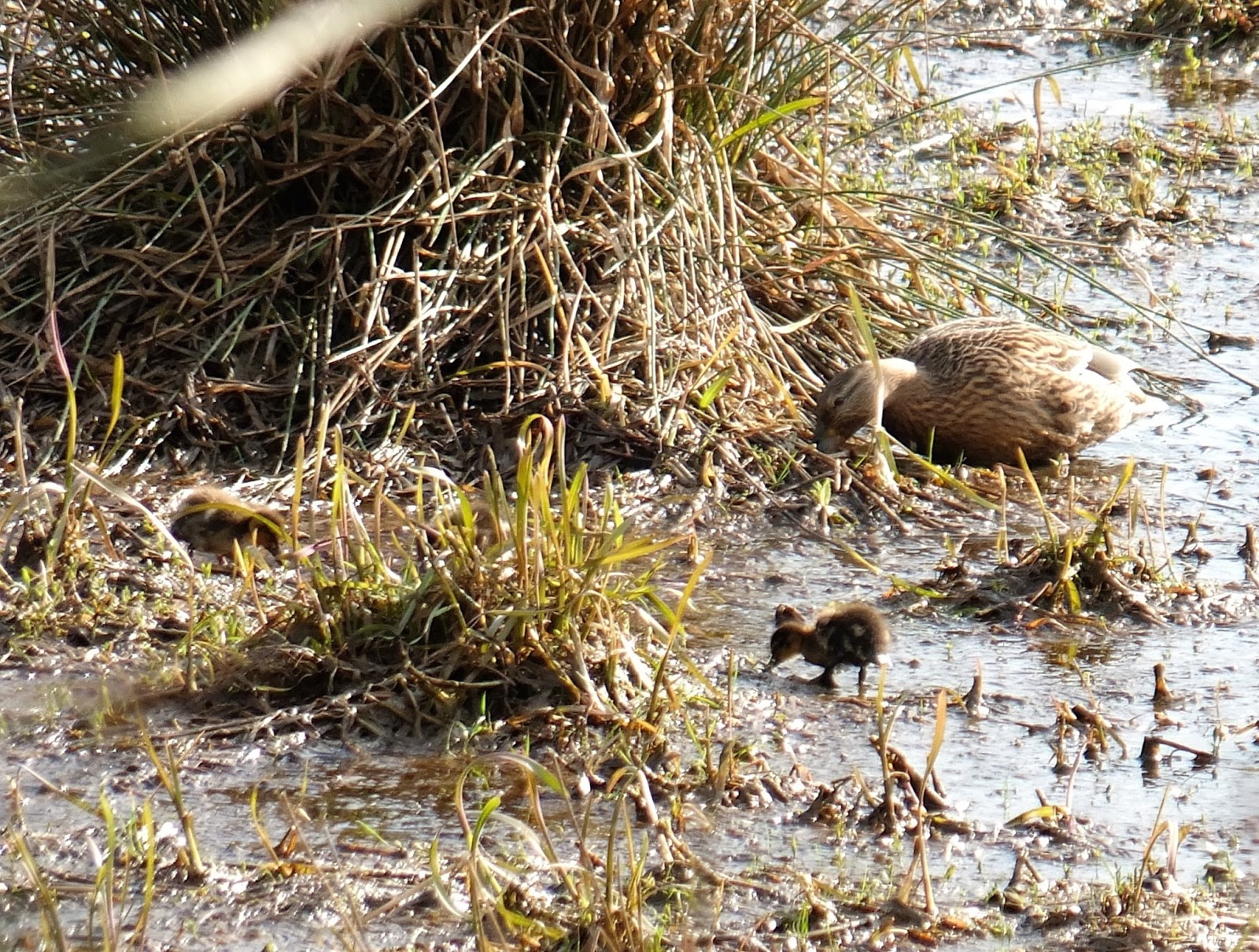
An after work visit to the patch produced at least six Chiffchaffs, one Blackcap and three Swallows on the migrant front, while the first Mallard ducklings of the year were out on Broadford Marsh. Other wildfowl were represented by at least twenty-nine Teal, half a dozen Shoveler and two Mandarin while the drake Gadwall was still present on St Catherine's Pool. Of note overhead were three Lesser Black-backed Gulls north and two Red Kites north-west together.
First ducklings of the year
Tuesday 5th April
A quick early morning dash round the patch before work again produced a handful of Chiffchaffs and Blackcaps, while wildfowl numbers were considerably lower than yesterday evening with just three each of Shoveler and Teal and two Mandarin of note. The two Little Owls were in their usual tree while noteworthy flyovers were two Greylag Geese south and a Skylark east.
Wednesday 6th April
An evening circuit of the patch after a day of showers. Of note were singles of Mandarin and Gadwall, a pair of Shoveler and nine Teal. Out in the horse field there were at least ten Pied Wagtails and three Fieldfare which may prove to be my last of the season. Pretty much the last bird of this evening's visit was a Peregrine flying over Broom Meadow.
Gadwall
Thursday 7th April
It had been another typical showery April day when I headed to the patch after work, and I hadn't walked far before the heavens opened again for a more persistent spell of rain which soaked me to the bone during my two hour visit. Wildfowl numbers are definitely dropping now, with just two pairs each of Teal and Shoveler around the place. The smaller birds were in fine voice despite the weather, including at least one Willow Warbler, and an unexpected Redstart (88) which sang briefly near the Riff Raff weir during another heavy burst of rain before disappearing behind a thick hedge where it called for a while then went silent. There were an impressive seventeen Pied Wags out in the horse field, while Broom Meadow harboured at least ten Linnets. Signs of movement overhead came in the form of two House Martins, two Grey Wagtails and a single Swallow, all heading north.
Saturday 9th April
An extended morning visit which again saw me dodging the showers. Overnight rain had clearly brought with it an increase in Blackcaps as there were at least six singing males around and an obvious pair flitting around together in the Broadford area. It was down this end of the patch I also found the first Carrion Crow nest of the year, plus a singing Willow Warbler.
Carrion Crow nest
Hirundine numbers are also on the up, with at least eight Sand Martins, six Swallows and two House Martins through during my visit, plus others too high to be identified with confidence.
Sand Martin
The drake Gadwall was again on St Catherine's Pool, but the only other wildfowl of note were three Mandarin. Raptors were up and enjoying the sunshine mid-morning, with at least ten Buzzards in and around patch airspace, two Kestrels and three Sparrowhawks, including a pair displaying. The Little Owl was also in its usual tree.
Richard Waters visited later and had nine Greylag Geese fly over.
Greylag Geese - Richard Waters
In the afternoon I took a stroll up nearby Pewley Down, hoping to finally catch up with a local Wheatear, but found just a single Yellowhammer of note.
Sunday 10th April
An early and frosty start for a dawn visit to my workplace Winkworth Arboretum (for the montly WeBS count) and nearby Thorncombe Street where I found three lingering Brambling up on 'The Ridge' and also heard my first Cuckoo of the year.
Another first for the year came on the patch a little while later with the familiar scratchy warble of a Whitethroat coming from an Elder bush by the railway line. Increasingly one of the most numerous warblers in Surrey, always great to see them return.
First Whitethroat of 2016 (honest!)
There were also at least six Blackcaps singing again and nine Chiffchaffs, including one pair already busy nest building near St Catherine's Pool. The Little Owl was again present as were at least two of the resident Kestrels (I think there are two pairs here now), while flyover highlights were a heard only Redpoll and two House Martins west.
Monday 11th April
A late afternoon visit today produced at least two Whitethroats singing along with the usual scattering of Chiffchaffs and Blackcaps. Wildfowl were represented by six Teal, one Shoveler and a pair of Mandarin while there were at least six Buzzards and a Sparrowhawk up in the sky, along with two Red Kites which flew north-west together, as they did on the 4th, but this time they later came back the same way, again flying in tandem.
Mandarins
It was good to meet fellow local bird Tim Staton who is a regular at Shalford - I'm not sure how it's taken me four months of patch watching the area to bump into him! We had a good chat about the area and other local birding highlights. As we were chatting four House Martins flew north.
Later on in the evening lengthsman Rob Craig reported a Little Egret.
Tuesday 12th April
An extended daytime visit to the patch after an early start for my first WBBS visit of the year to the river at Papercourt Water Meadows near Woking, which had given me my first Sedge Warbler of the year, plus singing Cuckoo and a Water Rail in flight along the river.
It was already a gloriously warm and sunny morning by the time I got to Shalford and the whole place was ringing with birdsong. Warbler numbers were particularly impressive, with at least twenty-three Chiffchaffs, fourteen Blackcaps, one Whitethroat and seven Willow Warblers across the recording area. The latter is particularly notable for a species which is increasingly a mere passage migrant in swathes of Surrey now.
The Chiffchaffs are now clearly pairing up fast and I watched several prospecting nest sites today. Raptors too were enjoying the spring weather with at least ten Buzzards airborne along with three Sparrowhawks, two Kestrels and two Red Kites. A Raven also drifted over very high going south-west mid-afternoon.
Raven (I did say it was high!)
Other signs of spring included two Mallard ducklings following a female along the navigation and Magpies gathering nesting material. Hirundines were represented by one House Martin, two Swallow and five Sand Martin. Other highlights from today were five Mandarin and three Little Grebes on St Catherine's Pool and the usual Little Owl pair again in their tree. It was also clearly an excellent day for butterflies as I saw my first Orange-tip, Holly Blue and Speckled Wood of 2016 along with at least ten Small Tortoiseshell, nine Brimstone and six Peacock.
Wednesday 13th April
Another largely fine day with just the odd shower and I again headed down to the water meadows after work. Plenty of warbler song again, with at least eleven Chiffchaffs and four Blackcaps. On St Catherine's Pool I found two Little Grebes and the drake Gadwall still present, while there a dozen very young Mallard ducklings on the navigation by St Catherine's Lock, including three pure yellow ones! Flyover highlights from this evening's visit were Sparrowhawk, a Red Kite east, one Swallow and a House Martin east.
One of the bright yellow ducklings at St Catherine's Lock
Thursday 14th April
After an absolutely stonking six hour Leith Hill tower migration watch this morning I wasn't expecting too much from my afternoon visit to Shalford - you can't expect fireworks all the time, especially when it comes to birding in Surrey.
The weather was also on the turn and rain was clearly on the way when I arrived at the patch.
Still, I again found the place alive with singing warblers; at least ten each of Chiffchaff and Blackcap and a single Whitethroat.
Storm clouds gathering over St Catherine's Lock
The last of the sunshine meant there were still several raptors up and about: at least two each of Buzzard, Sparrowhawk and Kestrel seen during my visit plus a single Red Kite west. Water birds were rather thin on the ground, or water, with just the lingering drake Gadwall, one Little Grebe and three Mandarin of note.
Overhead a couple of Swallows and House Martins passed through, while the butterflies were again out in force, with at least four each of Peacock and Small Tortoiseshell and singles of Comma and Brimstone seen.
Friday 15th April
A decent three hour visit to the patch this morning (I had a few days off this week in between finishing at Winkworth and starting my new job on the 18th) which produced 53 species. First up was an unexpected patch tick on one of the Broadford pools: a Great Crested Grebe (91) - not only my first record of one in the Chilworth/Albury/Shalford area in two years of living locally, but also the first time Rob Craig has heard of one here in all his time as lengthsman. There was also a trio of Tufted Duck in the same area; only my second record of this species at Shalford this year.
Warbler numbers were again good, with at least thirteen Chiffchaffs, six Blackcaps and four Whitethroats around. Out in the horse field Pied Wagtails were gathering nesting material while in Bog Meadow a pair of Reed Buntings were frequenting a bramble patch. Gull numbers have dropped right down in the past two or three weeks, so two Lesser Black-backed Gulls north-east were noteworthy. Hirundines were again trickling through with at least three Swallows and nine House Martins north, while two Sand Martins bucked the trend and flew south!
Saturday 16th April
Another three hour patch stint from dawn this morning produced 55 species. The Great Crested Grebe was still present in the Broadford area, as was a singing Willow Warbler - the first one for a few days. Other warblers were represented by at least eleven Blackcaps, nine Chiffchaffs and four Whitethroats. There was a fair amount of movement going on overhead, with five Greylags south-west, three Lesser Black-backed Gulls, two Herring Gulls andthe first Black-headed Gull for a while plus seven Swallows north. There were an impressive four Sparrowhawks in the air together at one point, all displaying and having a bit of a dogfight over Broadford - quite impressive to watch!
There were still a couple of Teal around in addition to two Mandarin, three Grey Herons and a Little Grebe.
Sunday 17th April
A morning spent surveying on the Ash Ranges produced my first Tree Pipits of the year, plus good numbers of Redstarts, Dartford Warblers, a trio of Woodlarks, a couple of Swallows and a flyover Cuckoo. In the afternoon my girlfriend and I paid a visit to our Shalford allotment where we had a single Swallow flying and singing low overhead as we dug, plus a flyover Redpoll.
It was only a brief visit to the patch this evening then, after all that, with again no new additions to the year list. It was nice to see half a dozen or so House Martins seemingly lingering over the village though, rather than just racing through, unlike the single Sand Martin which zoomed north low over Broom Meadow.
Never noticed this sign before - anyone fancy a long stroll?