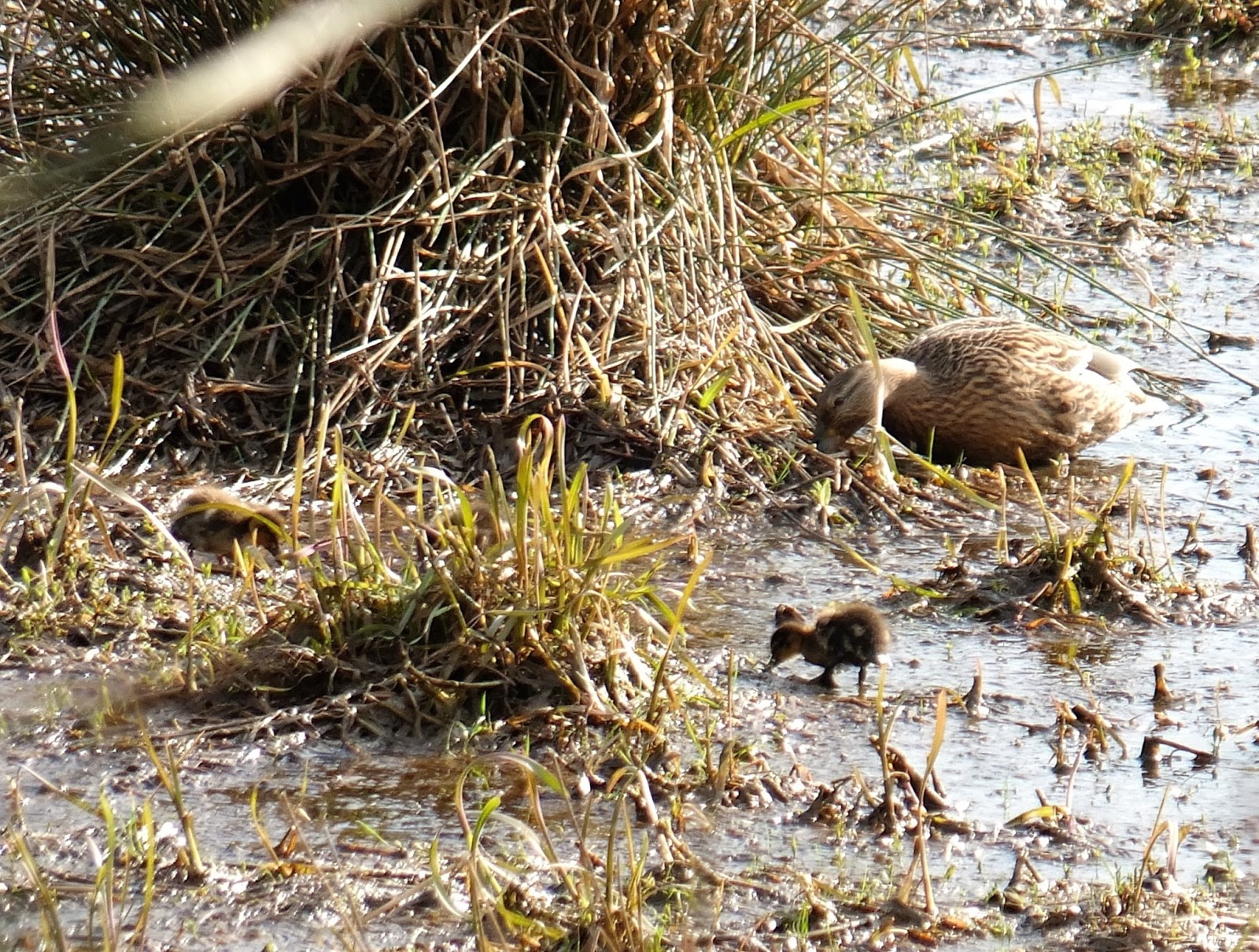
Well, what a few days it's been on the patch. The pair of Garganey stayed longer than expected and were enjoyed by at least 50 people. I met and chatted to visiting birders from West Sussex, London and all over Surrey, clearly enticed by some of the fantastic photos of the birds, a few of which I've included below.
Photo: Richard Waters
Photo: Dave Carlsson
Photo: Stevie Minhinnick
Photo: Richard Waters
Photo: Richard Waters
Photo: Richard Waters
Away from the main action on St Catherine's Pool, the first Blackcap (82) of the year was singing near the Dagley Lane allotments early on the 21st, before a more noticeable fall on the 30th when at least five singing males and a female were noted. Early on the 29th the first Willow Warbler of the year was singing by St Catherine's Pool. Chiffchaff numbers are steadily increasing, peaking at an impressive 17 males noted during a patch 'big day' on the 24th - but more on that later.
Chiffchaff - Richard Waters
Wildfowl numbers remain fairly decent with 27 Teal recorded on the 24th and two pairs of Gadwall on the 26th. There were also still two pairs of Shoveler present as of the 28th. There were three Egyptian Geese present in the Broadford area on the 24th, along with the usual numbers of Canada Geese and a single Greylag.
Teal - Richard Waters
Gadwall
Lingering winter visitors include singles of Redpoll over on the 24th, 25th and 27th and just a scattering of Redwing (4 on the 22nd, 3 on the 30th). Two Fieldfare flew west over the Horse Field on the 24th. Meadow Pipit passage is beginning to pick up now with several noted flying north on recent patch visits.
Back to the epic eight hour patch day on the 24th now which saw me notch up a patch record day list of 69 species, including my first Kingfisher (83) of the year, heard calling by the bridge where the Railway Line Walk crosses the river. Other highlights from the day included two Little Egrets flying north and a Firecrest in Mill Mead Meadow while an extended lunchtime skywatch from St Catherine's Hill produced 3 Red Kites, a male Crossbill flying east, an adult Great Black-backed Gull north and a Raven soaring high overhead before doing a couple of barrel rolls and flying west.
Buzzard - Richard Waters
The Little Owl in St Catherine's Meadow has been noticeably more vocal, giving its yelping call from one of the Oaks here both morning and evening on my recent visits.
After finding my first ever patch Red-legged Partridge on the 12th I've seen two together in the Horse Field/Broadford area a couple of times recently. The regular pair of Stonechat are still hanging around near St Catherine's Lock, while on the morning of the 30th a 'new' male was singing by Broadford Bridge.
The first patch Skylark of the year was heard singing to the west of Horse Field early on the 28th, while the first patch hirundine of the year was a Swallow seen by Kit Britten later the same day - exactly the same date as the first one in 2016.
The last week or so has seen a good emergence of the overwintering butterfly species, with Brimstone, Small Tortoiseshell, Peacock and Red Admiral noted in good numbers, plus a Small or Green-veined White seen briefly on the 26th in Mill Mead Meadow.
Small Tortoiseshell
As a final note on this post, thank you to Shaun Ferguson for producing this new map of the patch which you'll be able to find in 'The local patch' section of the blog, for reference.
It's been a quiet few weeks on the patch, hence the lack of blog posts, but there have been a few signs that autumn is on its way. It never makes me particularly popular with non-birding friends when I mention the A word at this time of year, but there's no denying the fact that the year is now turning.
Rainbow over Broadford Marsh
Aside from a steady south-westerly push of Swifts throughout the latter half of July, the first sure sign of return passage at Shalford came on the evening of the 12th when a Green Sandpiper dropped down onto Broadford Marsh during a rain shower. Only my second patch record this year after one in January. I really am hoping for something a bit rarer on this part of the patch at some point, if only it wouldn't keep drying out! At this point St Catherine's Pool is looking the best bet for a passing wader to drop in for a while.
Green Sandpiper (honest!)
Fast forward a couple of weeks and I heard the first returning Willow Warbler 'huu-weet'-ing just downstream from Broadford Bridge on 2nd August, followed by another or the same one a little way south-west of the bridge the following evening, and at least a couple in the same area on the evening of the 10th. Also adding an autumnal feel to my visit on the 3rd was an eclipse drake Teal on St Catherine's Pool - my first patch Teal since 19th April, and a sure sign of colder days ahead, albeit a little way off yet.
Teal
As you'd expect for the time of year there are now juvenile birds all over the patch, from Moorhens to Kestrels to Green Woodpeckers. One unfortunate young Moorhen fell victim to a Sparrowhawk on 21st July. Also of note recently were the adult and two juvenile Peregrines noisily flying over the patch early on 11th July. Mute Swans have returned to the river after successfully breeding on Shalford village pond. There's a lone sub-adult bird now hanging around at St Catherine's while a family group of two adults and two young were just upstream of Broadford Bridge on 31st July. Sand Martins have been pretty much a constant sight right through the breeding season, albeit in small numbers, usually hawking over Broadford Marsh or St Catherine's Lock. I don't know of any local breeding sites so it would be interesting to know the origins of these birds.
Mute Swans
Kestrel, juvenile
I've been mainly visiting the patch early morning the past few weeks as it fits better around work etc, but have been trying to make at least one evening visit a week, especially now the days are getting shorter again. On one such visit on 5th July it was good to see one of the local Barn Owls out hunting over Broadford Marsh, the first one I've seen here for a while.
On 7th July lengthsman Rob Craig messaged to say he'd just heard a Grasshopper Warbler reeling a little way downstream from St Catherine's Lock. Unfortunately I wasn't able to catch up with it either that day or the next, but still a great record - the first record for the area since one Rob heard at Broadford Marsh three years ago.
Gulls and geese are starting to move again after a bit of a midsummer lull. Early on 10th August singles of Egyptian Goose and Greylag Goose flew south/south-west along with a couple of dozen Canadas. Hopefully the coming weeks will bring something a bit rarer.
Just got back from a great few days staying on the Knepp Estate in West Sussex. Once used for intensive farming and grazing the 3500 acre estate has now been converted into one of the largest rewilding projects in lowland Europe thanks to the vision of Charlie Burrell, the owner of the estate and now chairman of Rewilding Britain. After finding the heavy weald clay tough-going when it came to producing crops, towards the end of the last century Charlie was looking for alternative ways to use the land and generate income for the estate. Having always had a passion for wildlife (he was nicknamed 'Bug' as a boy) a friend recommended he visit the Oostvaardersplassen project in the Netherlands, and it was this trip that inspired him to create his own rewilding project at Knepp.
Purple Emperor log mural at the Go-Down
Viper's-bugloss in the bank next to the car park
So it is that what were once arable crop fields are now teeming with brambles, hawthorn and wild roses. Hedgerows which were once flailed within an inch of their life are spreading and thickening, and roaming freely amongst all of this are the grazers, the drivers of ecology, as resident ecologist Penny Green refers to them. Exmoor ponies, English longhorn cattle, Tamworth pigs and Red and Fallow Deer (along with native Roe) wandering around a landscape largely devoid of fencing, just as their ancestral species would have done some five millennia ago. After just a decade and a half of this project the 'wildlands' of Knepp are already morphing into something incredible.
It really is hard to believe this was arable farmland fifteen years ago
In a way completely alien in comparison to most of the countryside of this part of the world, and yet also strangely familiar - some visitors to the estate have commented they are old enough to remember when more of the countryside looked like this. A time when Turtle Doves, Cuckoos and other farmland birds were thriving. And so far it seems these species are doing very well at Knepp, along with a whole host of other native wildlife. An estimated eleven pairs of Turtles Doves bred last year, while the estate also boasts 2% of the national breeding population of Nightingales since they returned in 2010 - the first time they'd been seen for fifty years. There are also excellent numbers of Barn Owls, Tawny Owls and Little Owls, not to mention Ravens, Hobbies and Spotted Flycatchers, to name a few. It's not just birds that are doing well at Knepp, as it is also famously home to the largest population of Purple Emperor butterflies in the UK, thanks to huge swathes of sallow which have colonised the Oak-lined damp fields which once harboured only monocrops.
Exmoor ponies
Barn Swallow
The obligatory friendly Robin in the camp kitchen
Toad near our tent on the first night, presumably well-fed on the
proliferation of slugs
I had heard so much about Knepp and wanted to visit for some time so was delighted when my girlfriend Kate booked the trip as a birthday present. We'd originally been scheduled to go on a Purple Emperor safari on the Sunday when we arrived, but were informed last week that due to the rubbish weather they had not emerged yet. No matter, as they offered us a place on a general safari tour on Monday instead, plus a reschedued Purple Emperor safari on 2nd July. The site tour was great and really helped us get some idea of the scale of the project here. Penny drove us around much of the southern block in an old six-wheel drive Austrian army vehicle and explained the aims of the project - basically what does happen if a large area of land is left largely unmanaged, aside from the actions of grazing animals? She explained how certain plants dominated but are now being replaced by other species; it must be fascinating to see a landscape evolve year on year like this. Although less than an hour from home, I can only equate some of the landscape at Knepp to the plains of Africa; this was especially the case when we stumbled across occasional herds of cattle, or piglets sleeping in the middle of the muddy tracks.
Longhorn cattle
Tamworth piglets
Hammer Pond - a haven for bats, wildfowl and invertebrates
Under reptile tins we found Grass Snakes and Slow-worms, as Garden Warblers sang in the swollen hedges. Penny also told us how thirteen of the eighteen native bat species are found here, and campsite manager Ryan Greaves kindly loaned us a bat detector which enabled us to have some close encounters with a few. We unfortunately didn't manage to track down a Turtle Dove but it's just great to know they're here and doing okay, for now at least. Perhaps we'll find one when we revisit at the weekend. I was lucky enough to chat to esteemed butterfly expert Matthew Oates a few times during our stay who did manage to find some Purple Emperors in the past couple of days, despite the changeable weather. In fact, the three he saw on Monday were the first recorded anywhere in the country this year. Despite exploring yesterday we unfortunately didn't find any Emperors but we did see good numbers of Marbled Whites, plus my first Purple Hairstreak and Small Skipper of the year.
Cinnabar moth - thriving at Knepp thanks to unchecked spread of
ragwort, their larval foodplant
Purple Hairstreak
I really cannot enthuse enough about how brilliant Knepp is, and how exciting it is to see such a massive swathe of countryside ' going back to nature'. I eagerly await our return visit on Saturday and the many more visits we will, I'm sure, be making after that to see how the place develops over time.
An after work visit to the patch produced at least six Chiffchaffs, one Blackcap and three Swallows on the migrant front, while the first Mallard ducklings of the year were out on Broadford Marsh. Other wildfowl were represented by at least twenty-nine Teal, half a dozen Shoveler and two Mandarin while the drake Gadwall was still present on St Catherine's Pool. Of note overhead were three Lesser Black-backed Gulls north and two Red Kites north-west together.
First ducklings of the year
Tuesday 5th April
A quick early morning dash round the patch before work again produced a handful of Chiffchaffs and Blackcaps, while wildfowl numbers were considerably lower than yesterday evening with just three each of Shoveler and Teal and two Mandarin of note. The two Little Owls were in their usual tree while noteworthy flyovers were two Greylag Geese south and a Skylark east.
Wednesday 6th April
An evening circuit of the patch after a day of showers. Of note were singles of Mandarin and Gadwall, a pair of Shoveler and nine Teal. Out in the horse field there were at least ten Pied Wagtails and three Fieldfare which may prove to be my last of the season. Pretty much the last bird of this evening's visit was a Peregrine flying over Broom Meadow.
Gadwall
Thursday 7th April
It had been another typical showery April day when I headed to the patch after work, and I hadn't walked far before the heavens opened again for a more persistent spell of rain which soaked me to the bone during my two hour visit. Wildfowl numbers are definitely dropping now, with just two pairs each of Teal and Shoveler around the place. The smaller birds were in fine voice despite the weather, including at least one Willow Warbler, and an unexpected Redstart (88) which sang briefly near the Riff Raff weir during another heavy burst of rain before disappearing behind a thick hedge where it called for a while then went silent. There were an impressive seventeen Pied Wags out in the horse field, while Broom Meadow harboured at least ten Linnets. Signs of movement overhead came in the form of two House Martins, two Grey Wagtails and a single Swallow, all heading north.
Saturday 9th April
An extended morning visit which again saw me dodging the showers. Overnight rain had clearly brought with it an increase in Blackcaps as there were at least six singing males around and an obvious pair flitting around together in the Broadford area. It was down this end of the patch I also found the first Carrion Crow nest of the year, plus a singing Willow Warbler.
Carrion Crow nest
Hirundine numbers are also on the up, with at least eight Sand Martins, six Swallows and two House Martins through during my visit, plus others too high to be identified with confidence.
Sand Martin
The drake Gadwall was again on St Catherine's Pool, but the only other wildfowl of note were three Mandarin. Raptors were up and enjoying the sunshine mid-morning, with at least ten Buzzards in and around patch airspace, two Kestrels and three Sparrowhawks, including a pair displaying. The Little Owl was also in its usual tree.
Richard Waters visited later and had nine Greylag Geese fly over.
Greylag Geese - Richard Waters
In the afternoon I took a stroll up nearby Pewley Down, hoping to finally catch up with a local Wheatear, but found just a single Yellowhammer of note.
Sunday 10th April
An early and frosty start for a dawn visit to my workplace Winkworth Arboretum (for the montly WeBS count) and nearby Thorncombe Street where I found three lingering Brambling up on 'The Ridge' and also heard my first Cuckoo of the year.
Another first for the year came on the patch a little while later with the familiar scratchy warble of a Whitethroat coming from an Elder bush by the railway line. Increasingly one of the most numerous warblers in Surrey, always great to see them return.
First Whitethroat of 2016 (honest!)
There were also at least six Blackcaps singing again and nine Chiffchaffs, including one pair already busy nest building near St Catherine's Pool. The Little Owl was again present as were at least two of the resident Kestrels (I think there are two pairs here now), while flyover highlights were a heard only Redpoll and two House Martins west.
Monday 11th April
A late afternoon visit today produced at least two Whitethroats singing along with the usual scattering of Chiffchaffs and Blackcaps. Wildfowl were represented by six Teal, one Shoveler and a pair of Mandarin while there were at least six Buzzards and a Sparrowhawk up in the sky, along with two Red Kites which flew north-west together, as they did on the 4th, but this time they later came back the same way, again flying in tandem.
Mandarins
It was good to meet fellow local bird Tim Staton who is a regular at Shalford - I'm not sure how it's taken me four months of patch watching the area to bump into him! We had a good chat about the area and other local birding highlights. As we were chatting four House Martins flew north.
Later on in the evening lengthsman Rob Craig reported a Little Egret.
Tuesday 12th April
An extended daytime visit to the patch after an early start for my first WBBS visit of the year to the river at Papercourt Water Meadows near Woking, which had given me my first Sedge Warbler of the year, plus singing Cuckoo and a Water Rail in flight along the river.
It was already a gloriously warm and sunny morning by the time I got to Shalford and the whole place was ringing with birdsong. Warbler numbers were particularly impressive, with at least twenty-three Chiffchaffs, fourteen Blackcaps, one Whitethroat and seven Willow Warblers across the recording area. The latter is particularly notable for a species which is increasingly a mere passage migrant in swathes of Surrey now.
The Chiffchaffs are now clearly pairing up fast and I watched several prospecting nest sites today. Raptors too were enjoying the spring weather with at least ten Buzzards airborne along with three Sparrowhawks, two Kestrels and two Red Kites. A Raven also drifted over very high going south-west mid-afternoon.
Raven (I did say it was high!)
Other signs of spring included two Mallard ducklings following a female along the navigation and Magpies gathering nesting material. Hirundines were represented by one House Martin, two Swallow and five Sand Martin. Other highlights from today were five Mandarin and three Little Grebes on St Catherine's Pool and the usual Little Owl pair again in their tree. It was also clearly an excellent day for butterflies as I saw my first Orange-tip, Holly Blue and Speckled Wood of 2016 along with at least ten Small Tortoiseshell, nine Brimstone and six Peacock.
Wednesday 13th April
Another largely fine day with just the odd shower and I again headed down to the water meadows after work. Plenty of warbler song again, with at least eleven Chiffchaffs and four Blackcaps. On St Catherine's Pool I found two Little Grebes and the drake Gadwall still present, while there a dozen very young Mallard ducklings on the navigation by St Catherine's Lock, including three pure yellow ones! Flyover highlights from this evening's visit were Sparrowhawk, a Red Kite east, one Swallow and a House Martin east.
One of the bright yellow ducklings at St Catherine's Lock
Thursday 14th April
After an absolutely stonking six hour Leith Hill tower migration watch this morning I wasn't expecting too much from my afternoon visit to Shalford - you can't expect fireworks all the time, especially when it comes to birding in Surrey.
The weather was also on the turn and rain was clearly on the way when I arrived at the patch.
Still, I again found the place alive with singing warblers; at least ten each of Chiffchaff and Blackcap and a single Whitethroat.
Storm clouds gathering over St Catherine's Lock
The last of the sunshine meant there were still several raptors up and about: at least two each of Buzzard, Sparrowhawk and Kestrel seen during my visit plus a single Red Kite west. Water birds were rather thin on the ground, or water, with just the lingering drake Gadwall, one Little Grebe and three Mandarin of note.
Overhead a couple of Swallows and House Martins passed through, while the butterflies were again out in force, with at least four each of Peacock and Small Tortoiseshell and singles of Comma and Brimstone seen.
Friday 15th April
A decent three hour visit to the patch this morning (I had a few days off this week in between finishing at Winkworth and starting my new job on the 18th) which produced 53 species. First up was an unexpected patch tick on one of the Broadford pools: a Great Crested Grebe (91) - not only my first record of one in the Chilworth/Albury/Shalford area in two years of living locally, but also the first time Rob Craig has heard of one here in all his time as lengthsman. There was also a trio of Tufted Duck in the same area; only my second record of this species at Shalford this year.
Warbler numbers were again good, with at least thirteen Chiffchaffs, six Blackcaps and four Whitethroats around. Out in the horse field Pied Wagtails were gathering nesting material while in Bog Meadow a pair of Reed Buntings were frequenting a bramble patch. Gull numbers have dropped right down in the past two or three weeks, so two Lesser Black-backed Gulls north-east were noteworthy. Hirundines were again trickling through with at least three Swallows and nine House Martins north, while two Sand Martins bucked the trend and flew south!
Saturday 16th April
Another three hour patch stint from dawn this morning produced 55 species. The Great Crested Grebe was still present in the Broadford area, as was a singing Willow Warbler - the first one for a few days. Other warblers were represented by at least eleven Blackcaps, nine Chiffchaffs and four Whitethroats. There was a fair amount of movement going on overhead, with five Greylags south-west, three Lesser Black-backed Gulls, two Herring Gulls andthe first Black-headed Gull for a while plus seven Swallows north. There were an impressive four Sparrowhawks in the air together at one point, all displaying and having a bit of a dogfight over Broadford - quite impressive to watch!
There were still a couple of Teal around in addition to two Mandarin, three Grey Herons and a Little Grebe.
Sunday 17th April
A morning spent surveying on the Ash Ranges produced my first Tree Pipits of the year, plus good numbers of Redstarts, Dartford Warblers, a trio of Woodlarks, a couple of Swallows and a flyover Cuckoo. In the afternoon my girlfriend and I paid a visit to our Shalford allotment where we had a single Swallow flying and singing low overhead as we dug, plus a flyover Redpoll.
It was only a brief visit to the patch this evening then, after all that, with again no new additions to the year list. It was nice to see half a dozen or so House Martins seemingly lingering over the village though, rather than just racing through, unlike the single Sand Martin which zoomed north low over Broom Meadow.
Never noticed this sign before - anyone fancy a long stroll?