Showing posts with label local birding. Show all posts

Monday, 7 August 2017

Farewell to Chilworth: the end of a garden list.

I must start by acknowledging Ed's blog post about leaving behind his family home as inspiration in part for the following.

Moving house is always a wrench. So many emotions rolled into one. Not least, for a birder, the feeling of finality about the garden list. A slowly accumulating total that seemed like it would go on for ever must sadly come to an end. It's the ultimate in patch watching really, isn't it? There's something particularly wonderful about seeing birds in, from and above your own little patch of land, and even more so when something wholly unexpected makes an appearance.

After almost three years enjoying the pretty wonderful view from our garden on Sample Oak Lane in Chilworth, my girlfriend Kate and I have now left the Surrey Hills behind us. In fact we've left the county altogether, heading south to Pulborough in West Sussex where our new garden backs directly onto the wildbrooks. To say I'm looking forward to our future there and the birds we'll add to the garden list is something of an understatement (already on 75 species after just over a month!) but, as we have now come to the end of our tenancy and returned the keys, I thought I'd just pay homage to that which we have left behind and the very respectable list of 92 bird species I recorded in, over or from our Chilworth garden in our 34 and a bit months there.

(Unfortunately I've only realised since I started writing this that I didn't take a great deal of photos of the birds in and over the garden so some imagination will be required...)
Looking south-west from the house
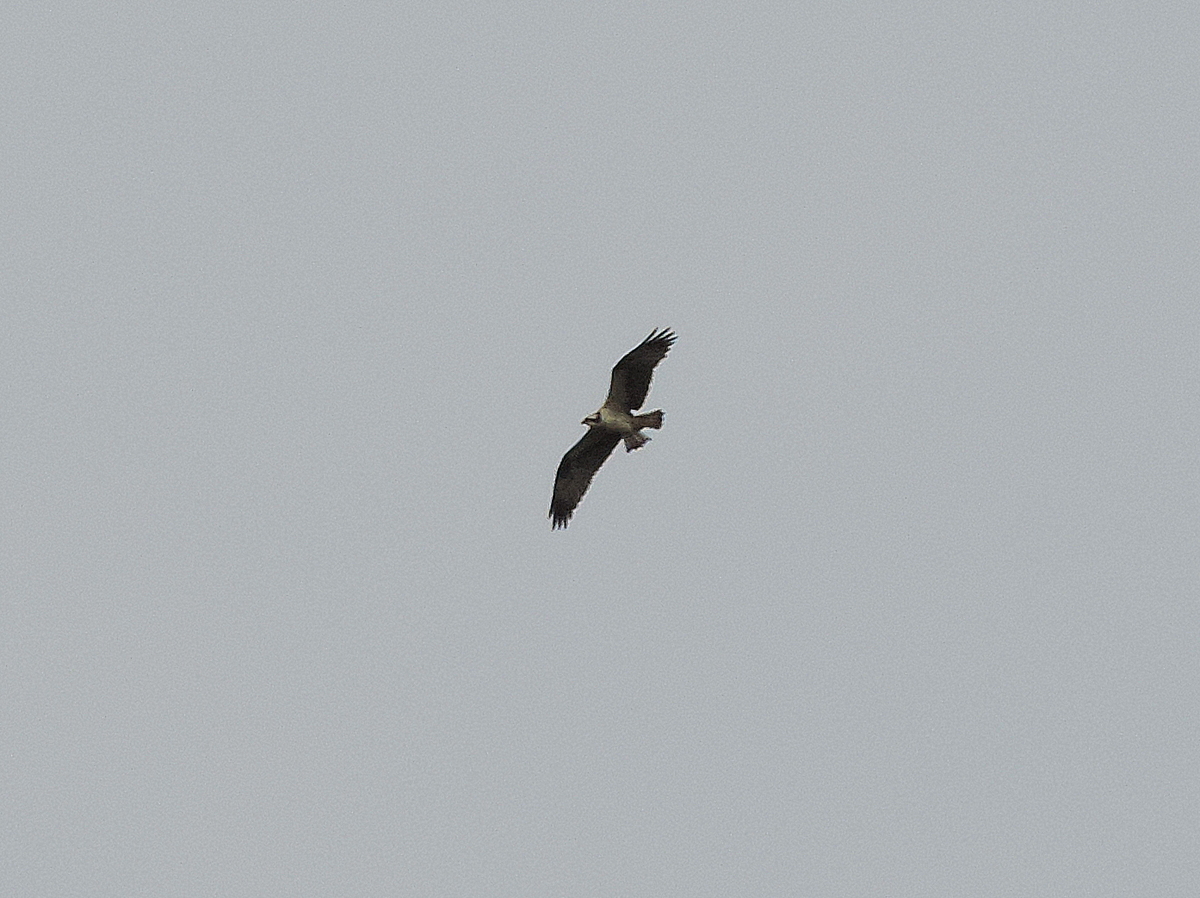
The garden list got off to a pretty good start, with a Red Kite circling overhead on the day we first viewed the house in July 2014. At that time this species was already becoming a pretty common sight locally, but still a good omen for what was to come. The second raptor on the list was added on moving day a few weeks later and was certainly not the species I would have expected. As we finished lugging in the last of the boxes and with little more than Blue Tit and Robin added to the garden total, Kate drew my attention to a bird of prey getting mobbed by Crows over the fields to the south-west. 'Probably just a Buzzard', I said. No sooner had those words left my mouth though, than the bird turned to reveal its gleaming white underparts and long kinked wings. I sprinted upstairs to my scope (which of course I had already set up in the spare room) and just managed to get enough on the bird to realise it was obviously an Osprey before it flew off over the trees to the south. I needn't have rushed, as the bird was clearly lingering in the area and I saw it several times again over the course of the next few days before eventually watching it fly off high south one morning. This was a species I went on to record on a further two occasions over the garden but never quite so memorably as that first time.
Osprey over Chilworth, 30th August 2014
Over the coming weeks our first autumn in the house produced flyover Yellow Wagtail, a slightly late Swift (we moved over the August Bank Holiday so I assumed I'd have to wait until the following spring for this one), Hobby and regular Tawny Owl and Little Owl. The latter species seemed to become a less frequent occurrence over time, sadly, and by this year it was one I only heard very occasionally calling rather distantly to the north. Interesting viewpoint from Steve Chastell on this was the suggestion that Little Owls are becoming increasingly secretive as Buzzards and the like become more common, which seems logical to me. I certainly seemed to hear them a lot more often than I saw them on my Shalford patch as well. Barn Owl was only recorded once, with one hunting over the fields on the other side of the road from us on 31st August 2015. Ravens were recorded on occasion, peaking at three over together on 3rd April this year, although I perhaps didn't see them quite as often as I expected given their increase as a local breeder. Still, along with Red Kite, a sign of the changing times in the fates of various bird species in this part of the country. Another sign of this was the fact that I only recorded Yellowhammer maybe two or three times flying over the garden where once upon a time I'm told they were singing from every other hedgerow between Guildford and Albury.
Raven over the garden

Despite my best efforts the garden itself had relatively little in the way of vegetation to hold many birds beyond the common Tits, Robins and Dunnocks but the trees and hedges nearby attracted warblers in the form of regular Chiffchaff, Willow Warber, Blackcap and once a Whitethroat. Marsh Tit was recorded just once passing through the roadside hedge, sneezing as it went. One species I was surprised never to record from the garden was Firecrest, especially given how common they are becoming in the local area - I often saw and heard them just a little way up the road.

As has been well documented the whole Tillingbourne stretch through Albury and Chilworth towards Shalford is a popular wintering spot for Little Egrets so it wasn't surprising to see this species flying over the garden in the winter months, or occasionally in the fields beyond our garden. What was less expected though was the Great White Egret which flew over at dusk on 30th October 2016 - a Surrey lifer for me, from the comfort of my patio no less! Magic.

With there being a large private water body (labelled 'Fish Pond' on the OS map) just a few hundred yards to the west of the garden it was no surprise to see Mallards and Mandarins regularly flying over, along with Canada Geese, Cormorants, Grey Herons, etc. More unusual flyovers came in the form of Tufted Duck, Shoveler and Gadwall. Waders were unsurprisingly particularly hard to come by around these parts, so a flyover Green Sandpiper on 24th July 2016 and two Curlew over on 1st June this year were both very welcome additions indeed (the latter in fact turned out to be the final new species on the garden list).

The most astounding and memorable moment though was surely the pair of Common Cranes which flew south on the morning of 2nd May this year. To this day I still almost can't believe it actually happened. You can read my full account of that morning here if you'd like to and haven't already done so.

It wasn't just the nearby water producing some decent garden ticks though. Having Blackheath just a little way to the south-east at the top of the road was clearly also very helpful with Cuckoo a reasonably regular sound in the early summer months and one even flying north over the garden on 22nd April 2016. Siskin were a regular feature throughout the year particularly in the winter when they flocked together with the Goldfinches in the Alders across the fields towards Fish Pond. Other heathland wanderers included occasional Crossbills, and a Woodlark which flew north-west on 21st September last year. Best of all though was the Nightjar that was heard churring somewhere to the south of the garden on the night of 21st May this year.

Only time would have told whether a few more years there would have seen my garden list emulate fellow Chilworth birder Ernest Garcia's list of 108 species (which by the way includes Whimbrel, Wryneck, Willow Tit and Goosander!) but regardless I will still always remember fondly the birding memories I made in this little corner of the Surrey Hills. 
In the garden soon after moving in - in summer plumage!


Monday, 1 May 2017

Shalford patch diary, 18th-28th April

Late April is surely one of the most exciting times of year to be a watcher of a local patch, when each day seems to bring new surprises and regional scarcities take on the guise of megas - a patch year tick or even better a patch lifer delivering all the excitement and more of connecting with a brand new species.

Despite the persistent lack of rain, late frosts and pesky northerly winds it's been a pretty great ten days at Shalford with seven year ticks, one of them a first for the site as far as I'm aware.

18th April

A good start to the new week after the Easter weekend. In the scrub between Horse Field and the Railway Triangle I discovered first a Chiffchaff with an interesting 'swee-oo' call (thanks to David Darrell Lambert for info and ID help on this. Further reading here: http://birdingfrontiers.com/2011/07/23/swee-oo-calling-chiffchaffs/) and then a Nightingale singing intermittently in the bushes right by the railway line. No doubt there have been previous records but as far as I can tell it's the first documented site record and a very nice way to notch up my 90th species on the patch year list! On to St Catherine's where I found the regular pair of Stonechats still in attendance in St Catherine's Meadow along with the first Sedge Warbler of the year singing in Broom Meadow. Other bits of note from today included one Red Kite, six Whitethroats, two House Martins, one Swallow and one Willow Warbler.


19th April

Rather quieter today after yesterday's excitement. Indeed, the Nightingale and Sedge Warbler were both missing in action. The highlights from today's two visits were the pair of Red-legged Partridges in Horse Field, three Stonechats and five Whitethroats. A Greenfinch was observed nest-building while three Lesser Black-backed Gulls flew north.
Lesser Black-backeds on the move


20th April

A very quiet skywatch from St Catherine's Hill this morning was saved at the last minute by a Cuckoo singing down in the meadows below. The 93rd species on the Shalford year list and my 92nd. Kit Britten, meanwhile, was down at ground level at the same time I was up the hill and was rewarded with a very smart male Redstart at St Catherine's Pool - the first of the year here. Sand Martins - three in total - were still whizzing about checking out the railway embankment on the side of the hill while the only apparent movers were singles of Grey Heron and Herring Gull north. A male Sparrowhawk posed briefly in a tree by the hill.
Sparrowhawk
An evening visit to the patch sadly produced neither Cuckoo or Redstart, but a Water Rail squealed at St Catherine's Pool and four House Martins were hawking over the rooftops of Shalford village.

21st April

Another pre-work stroll around the meadows produced the first Garden Warbler of the year singing in the brambles by Dagley Lane allotments. Other bits of note were the Stonechat pair again in St Catherine's Meadow, three Mandarins and at least two Kestrels.
Stonechat

22nd April

A quiet couple of hours down the southern end of the patch was enlivened by a message from Kit Britten who'd just found two Common Sandpipers up at St Catherine's Lock. I raced up to find at least one bird still present although flighty. While we were at the lock five Sand Martins flew north along the river. Kit also informed me he'd just seen one of the adult Stonechats carrying a fecal sac in St Catherine's Meadow - great to confirm breeding here after it was suspected in 2016.
An afternoon skywatch from the Horse Field, meanwhile, produced the first Reed Warbler of the year, singing very occasionally from a dense Blackthorn on the eastern edge of the field. There wasn't a great deal of stuff flying over aside from one Peregrine, two Red Kites, two House Martins and three Swallows.
Another two patch year tick day taking the total Shalford year list to 97 and my own total to 95.

23rd April

A rather quiet afternoon visit after an extended Leith Hill tower migration watch in the morning, though it was nice to catch up with Richard Waters. At least four Buzzards were up and displaying in the warm sunshine along with a single Red Kite. There were plenty of Whitethroats around including two males squabbling in Broom Meadow. A Little Owl was calling in one of the usual Oaks in St Catherine's Meadow, although heard from Railway Triangle. The Stonechat pair were again busy in St Catherine's Meadow while hirundines were represented by six Swallows and four House Martins.

24th April

It was pretty clear a few minutes into this morning's visit there'd been a big arrival of Whitethroats overnight, with at least seventeen singing males just in the St Catherine's/Broadford area alone, one already nest building in brambles by the Horse Field. Otherwise it was a fairly quiet visit with just a singles of Swallow and Sand Martin over and a Skylark singing west of Horse Field.
Whitethroat

25th April

Despite the much colder conditions and north-westerly wind, evidently some migrants were still filtering through as this morning there were apparent new arrivals of Garden Warbler, Sedge Warbler and Willow Warbler, singing by St Catherine's Pool, in Mill Mead Meadow and by the Guildford Park & Ride, respectively. Also of note were five Swallows, the usual two Red-legged Partridge, a singing male Stonechat on Broadford Marsh along with the usual St Catherine's pair plus a dozen Whitethroats, and a Skylark which flew west.

26th April

Clearly an overnight fall of Garden Warblers had occurred with at least four singing around the mid-patch this morning - one by the Horse Field, one by St Catherine's Pool, one in Broom Meadow and one in Mill Mead Meadow. There were at least eleven singing male Whitethroats, while it was good to confirm the presence of two pairs of Stonechat - one in the Railway Triangle and one at St Catherine's. It will be interesting to see if yesterday's singing male at Broadford turns out to be one of a third pair. Overhead, four Herring Gulls flew north while five House Martins moving strongly south-west were surely evading the incoming weather front, and I can't say I blame them!


27th April

A rare day away from the patch for me as I had a lie-in (shocking, I know) then dashed to Island Barn Reservoir after work to twitch the Red-rumped Swallow Dave Harris had just found. A very nice bird indeed - wouldn't mind one of those at Shalford!
Kit did make it down the patch, however and was rewarded with two Garden Warblers, a Sedge Warbler and a showy female Bullfinch, this species continuing to do well here with at least two pairs around.
Bullfinch - Kit Britten


28th April

Rather more clement this morning after some quite severe frosts for the time of year earlier in the week. At St Catherine's Lock I found another flighty Common Sandpiper plus the usual pair of Stonechats. There were three Garden Warblers singing, one Sedge Warbler in Mill Mead Meadow and a dozen Whitethroats around, including one gathering nesting material again. The visit was rounded off nicely by a Peregrine flying over.


Tuesday, 4 April 2017

Further adventures in micro-patching

Having always been a keen patch-watcher, I must admit to quite enjoying this spell of medically-enforced micro-patching - i.e. my garden and its immediate surroundings. On the eve of leaving Chilworth and the Surrey Hills behind, I feel like it's making me take time to appreciate my surroundings and look harder for things I may have missed. Indeed, since returning from hospital on Saturday afternoon I've notched up 56 bird species in, around or over the garden, although still yet to achieve the hoped-for 50 in a single day.
Dunnock
Yesterday's highlights included singles of Sand Martin and Swallow over, one Skylark east (the first garden record for a while), an adult Great Black-backed Gull east and ten Redpoll high north-west. It was also entertaining watching four Great Spotted Woodpeckers chasing each other from tree to tree on and off all morning. Butterfly numbers were lower than Sunday, as to be expected as the day was rather cooler and breezier, with just Comma and Holly Blue making an appearance. It's worth mentioning here that our back garden is a very open space and backs directly onto farmland. It can often be very breezy here when other places locally are calm - I've often equated it to being rather more like being by the coast than the Surrey Hills! Anyway, I've no doubt a dweller of a more sheltered garden would have done rather better for butterflies but, as it stands, my garden butterfly year list now stands at seven species.
Carder Bee
This morning started drizzly but mild and with relatively light winds. Normally the kind of morning I'd be scurrying off to the patch but not today. I'd barely finished my breakfast before I heard the sweetly drunken notes of a Willow Warbler singing through the open window; the first one from the garden this year. Not a bad start.
Willow Warbler - too mobile for a good photo!
I got my bins and camera out and before setting up for some more sedentary garden birding headed out for a gentle stroll up our road. I had half thought I might make it up to Blackheath but didn't get that far in the end. Anyway I hadn't walked far before I caught up with the Willow Warbler again, working its way through the roadside hedgerow, occasionally darting to the top of a taller tree when a car passed by. It was nice to spend some time watching it. Maybe I'm usually in too much of a rush to find something else.

A little further on I stumbled across a pair of Buzzards mating in a tree right on the edge of Blackheath, and my first Red Kite of the day drifted over. Down at ground level it was nice to see my first flowering Cow Parsley and Garlic Mustard of the year; some of the Hawthorns don't look like they'll be much longer either.
Blackthorn
Garlic Mustard
Cow Parsley
Forget-me-not species - probably garden escape
 Back home and into my sky watching position from where I could still hear occasional bursts of song from the Willow Warbler, plus at least one each of Chiffchaff and Blackcap behind the farm. A pair of Jackdaws foraged about nearby gathering nest material. Looking up I caught sight of three Ravens powering north together, sadly disappearing over the tree line before I could get a photo. Later on two Skylarks flew north-east. The hoped for low cloud and occasional drizzle sadly didn't bring down a Little Gull or any terns but single Lesser Black-backed Gulls flew south and south-west. As the day brightened a little mid-afternoon, raptors really got going with at least four Red Kites and nine Buzzards in the sky together at one point, seven of the latter kettling together and drifting north-east. Despite my best efforts I've not yet found any grounded passerines in the fields that back onto our garden but I'm certainly enjoying trying! The garden list remains on 88.
Buzzard

Pheasant

Cormorant - lots of these over the garden this week


Saturday, 1 April 2017

Shalford patch diary, late March

Well, what a few days it's been on the patch. The pair of Garganey stayed longer than expected and were enjoyed by at least 50 people. I met and chatted to visiting birders from West Sussex, London and all over Surrey, clearly enticed by some of the fantastic photos of the birds, a few of which I've included below.
Photo: Richard Waters
Photo: Dave Carlsson
Photo: Stevie Minhinnick

Photo: Richard Waters

Photo: Richard Waters

Photo: Richard Waters
Away from the main action on St Catherine's Pool, the first Blackcap (82) of the year was singing near the Dagley Lane allotments early on the 21st, before a more noticeable fall on the 30th when at least five singing males and a female were noted. Early on the 29th the first Willow Warbler of the year was singing by St Catherine's Pool. Chiffchaff numbers are steadily increasing, peaking at an impressive 17 males noted during a patch 'big day' on the 24th - but more on that later.
Chiffchaff - Richard Waters
Wildfowl numbers remain fairly decent with 27 Teal recorded on the 24th and two pairs of Gadwall on the 26th. There were also still two pairs of Shoveler present as of the 28th. There were three Egyptian Geese present in the Broadford area on the 24th, along with the usual numbers of Canada Geese and a single Greylag.
Teal - Richard Waters
Gadwall
Lingering winter visitors include singles of Redpoll over on the 24th, 25th and 27th and just a scattering of Redwing (4 on the 22nd, 3 on the 30th). Two Fieldfare flew west over the Horse Field on the 24th. Meadow Pipit passage is beginning to pick up now with several noted flying north on recent patch visits.

Back to the epic eight hour patch day on the 24th now which saw me notch up a patch record day list of 69 species, including my first Kingfisher (83) of the year, heard calling by the bridge where the Railway Line Walk crosses the river. Other highlights from the day included two Little Egrets flying north and a Firecrest in Mill Mead Meadow while an extended lunchtime skywatch from St Catherine's Hill produced 3 Red Kites, a male Crossbill flying east, an adult Great Black-backed Gull north and a Raven soaring high overhead before doing a couple of barrel rolls and flying west.
Buzzard - Richard Waters
The Little Owl in St Catherine's Meadow has been noticeably more vocal, giving its yelping call from one of the Oaks here both morning and evening on my recent visits.

After finding my first ever patch Red-legged Partridge on the 12th I've seen two together in the Horse Field/Broadford area a couple of times recently. The regular pair of Stonechat are still hanging around near St Catherine's Lock, while on the morning of the 30th a 'new' male was singing by Broadford Bridge.

The first patch Skylark of the year was heard singing to the west of Horse Field early on the 28th, while the first patch hirundine of the year was a Swallow seen by Kit Britten later the same day - exactly the same date as the first one in 2016.

The last week or so has seen a good emergence of the overwintering butterfly species, with Brimstone, Small Tortoiseshell, Peacock and Red Admiral noted in good numbers, plus a Small or Green-veined White seen briefly on the 26th in Mill Mead Meadow.
Small Tortoiseshell
As a final note on this post, thank you to Shaun Ferguson for producing this new map of the patch which you'll be able to find in 'The local patch' section of the blog, for reference.

Sunday, 26 February 2017

Shalford patch diary, 2017 so far

I've got a bit out of the habit of doing my regular patch diary blog posts so am going to attempt to summarise the first seven or so weeks of 2017 in this one with as little waffle as possible! As I write this the patch year list stands on 75, just one behind this time last year and with several 'easy' species still missing, most notably Tawny Owl! One of the best things about patch watching though is it makes otherwise common species more rewarding when they do make an appearance, and it's been interesting to note several species that have been recorded earlier this year than last, and others that have been notable by their absence.

Greylag Goose is the third most commonly seen goose species on the patch and only ever seen in smallish numbers in 2016, so it was quite surprising to see approximately 70 flying NNE from Loseley direction towards Guildford on 28th January. Canada Geese are just as common as ever, with reasonable numbers (20-30) flying in to roost on St Catherine's Pool on all my evening visits recently. As was the case last year Egyptian Goose seems to be largely a flyover species here, so it was a bit of a surprise to see a pair in the dead tree in Broadford Meadows on 5th February, seemingly vying with a gang of Jackdaws over a nest box. Then this weekend a pair seem to have taken a liking to the St Catherine's Pool/Broom Meadow area, having been seen either on the water or in one of the Oaks here the past couple of days.
Egyptian Goose
Moving on to ducks, it took me until the end of March last year to record Wigeon on patch, with the 31st March birds remaining my only Shalford record until 7th January this year when I heard that familiar whistling call somewhere over Broom Meadow at first light, this then followed by two drakes on St Catherine's Pool during my WeBS count on 12th February. Shoveler, on the other hand, have been rather more elusive this winter than last, with the first ones not seen until 30th January. They've since been a fairly regular feature, peaking at 11+ on 12th February.
Wigeon and Shoveler flying off from St Catherine's Pool - great photo, I know

Another duck species that took me until spring last year to add to the patch list was Gadwall so it was nice to find a pair on Broadford Marsh on 12th February, again during my WeBS count. As was the case last winter, Teal is rivalled only by Mallard as the commonest duck on the patch. They tend to be quite scattered around the area though so it's hard to get an accurate count, but numbers of between 15 and 25 are regular, with a high count of 30+ on 15th January. Mandarin Ducks have been around in small numbers, peaking at at least 6 on 19th and 25th February - 4 flew from roost below St Catherine's Hill early on the latter date.
Gadwall

Teal
There's been at least one Little Grebe kicking about since the middle of January, mostly on the navigation downstream of St Catherine's Lock although more recently I've had one on St Catherine's Pool on a couple of occasions, where they bred last year. It was particularly unusual seeing one swimming amongst the trees in Mill Mead Meadow after the river burst its banks a few weeks back!
Little Grebe

On to gulls, and it's been the usual palette of Herring, Common and Black-headeds flying over recently, peaking at either end of the day, some of the latter occasionally coming down to check out the river or flying low over Dagley Lane towards the village green. Lesser Black-backeds are rather less common and I've had just one record of Great Black-backed Gull so far: one adult flying high south-west on 21st January.
Three species of wader have made it onto the year list so far, with Lapwing perhaps the most notable. In 2016 I only had a handful of records of this species, mostly in small numbers aside from a flock of 26 over in October. Again it was good to get them on the year list early this year with a flock of c.35 wheeling around towards Loseley on 21st January followed by around 30 flying over the same area on 5th February, then half a dozen north-east on 26th February. Keeping with the theme of record breaking counts, there were at least 18 Snipe towards the northern end of Broom Meadow near St Catherine's Lock on 7th January - by far my highest count here! Still waiting to find that Jack though... I did quite well for Woodcock on the patch last year, with several records in January/February. I was glad then to finally add the species to the 2017 year list when two flew up from Broadford Marsh and right over my head at dusk on 15th February.
Lapwings (you'll have to take my word for it!)

Little Egrets are a frequent sight in this part of the county in winter now and Shalford is no exception, with several records of this species on the patch already in 2017, most recently one which flew up from near St Catherine's Hill on 25th February.
Little Egret
Up until this week Barn Owl was the only Owl species I'd recorded on the patch in 2017 with up to two present at times. Hopefully this species will breed here this year after no proven breeding records in 2016. On the 21st of this month though Barn was joined on the year list by at least one Little Owl calling at dusk - first at the southern end of St Catherine's Meadow (their favoured area last year) then closer to the lock, seemingly in a tree right by the navigation, though it was too dark to see. Whether this was one bird or two I'm not sure but I'll be monitoring them closely as this is my first record of the species here since last June.
Red Kite
Moving onto raptors now and the first patch Red Kite of the year was recorded on 21st January followed by singles on the 4th, 5th, 25th and 26th February. As with Buzzards in this area it's becoming increasingly hard to separate the locals from the movers but it's certainly good to see both these species becoming such a regular sight. Talking of Buzzards, there seems to be a pair hanging around in the same area that they bred last year which is good news. Last year I also suspected Sparrowhawks to have bred in the Broadford area and I've already seen birds displaying around here again on warmer days recently. Last week a male was loitering around in the trees in the same area.

Kestrel remains the most regularly seen raptor on the patch with at least one or two present on all visits. This morning (26th) it was good to see a pair hanging around near one of the nest boxes towards the southern end of the patch. My only Peregrine record of the year so far was one that flew south-west over St Catherine's Lock on 28th January.
Kestrel
Fieldfare have been in rather short supply so far this year but there's a fairly decent Redwing flock kicking around, usually scattered about in the wetter areas of Mill Mead Meadow and Broom Meadow. Stonechats have been a fairly consistent sight so far this year with up to three present on the 7th and 14th January. I hadn't seen one for a week or two until yesterday though when a female was near Broadford Bridge. I'm finding Firecrest rather harder to find this winter than last with my only record so far one in the bank of Holly along the Railway Line Walk on 5th February.
My first skywatch from St Catherine's Hill of the year on 25th February produced the first Raven record of 2017 with two flying west not long after 7am, seemingly coming up from roost in the trees on the north-east side of the hill. This is exciting as all my previous records of this species involved high-flying birds simply passing over the patch.
A very obliging Greenfinch in Broom Meadow
Siskins are an ever present species at this time of year with good numbers around, particularly in the Alders at the top of Broom Meadow, but not quite so many as last winter - c.120 on 15th January my highest count so far, and not a sniff of a Redpoll! Compared to last winter, there are lots more Linnets around and I've noticed they are roosting in the bushes in Broom Meadow -  at least 30 coming into roost on 22nd January.
The same skywatch on 25th February that delivered Raven also yielded the first Crossbill of the year, with one flying in from the direction of the Chantries before turning and flying south. Another species that has made it onto the patch year list earlier that in 2016 - considerably earlier in fact, as it took until October to record one last year. Given the amount of records of possible breeding in the county this year this is not exactly surprising but a very welcome addition nonetheless.
Reed Buntings are now back on the patch in reasonable numbers with at least half a dozen around since early February, and a pair already looking to be checking out nest sites in St Catherine's and Broom Meadows.
Reed Bunting


Saturday, 1 October 2016

Shalford patch diary and local round-up, late September

Now we're past the autumn equinox it's getting to that time of year where patch birding is soon to become a weekend affair, with usable daylight before and after work fading rapidly. Nonetheless, recent early and late visits to Shalford Water Meadows have produced the odd spark of interest as well as treating me to some pretty spectacular sunrises and sunsets.
Heading back to my car after a pretty quiet post-work visit on the 20th something caught my eye flying down from a tree near the Dagley Lane railway bridge. Looking over the side of the bridge I saw a Kestrel that had clearly just caught something in the vegetation beside the railway line - a Slow-worm! I managed to film some of its struggle with the unfortunate reptile.
 
I also noticed the bird was sporting a blue leg ring. Knowing he rings lots of Kestrels in this part of the world I sent the video to Jeremy Gates who was able to confirm this was the only sighting to date of a female he ringed in Worplesdon back in May 2014.
The other big bit of news recently has been the rain. After an extended spell of hot and dry weather to start the month the first substantial rainfall in what seemed like ages came on the 16th and it was a joy to head out to the patch the following morning to find some of the pools filling up again. Out on Broadford Marsh there were at least four Grey Wagtails plus the first three Snipe of winter. Wildfowl numbers will hopefully start to build now that there's actually some habitat for them again - on the 25th there were at least ten Teal and a dozen Shoveler around.
Grey Wagtail

Greylag Geese
As I mentioned in my previous blog post the hirundines are now well and truly gathering to leave us for the winter. The House Martin nests on Kings Road in Shalford were all empty by the 18th and there have been some pretty impressive numbers of them over the patch recently (see further down this blog post for more on that).
House Martin nest on Kings Road
After the remarkable passage of Yellow Wagtails on the 8th I decided it was high time (no pun intended) I sought out a decent visible migration watch-point within the patch boundaries, so I checked out St Catherine's Hill to the north-west of St Catherine's Lock and discovered the vantage point to be excellent, looking right out across much of the water meadows, with a clear view north to Guildford and beyond, south towards Bramley and Godalming and east towards Pewley Down and the Chantries.
Looking east from St Catherine's Hill
Sunrise from St Catherine's Hill
  I'm actually slightly annoyed with myself for not exploring the hill sooner to be honest as the first few watches I've done in the past fortnight have proved productive. A drizzly hour on the 17th yielded at least 400 each of House Martin and Swallow west/north-west plus an adult Great Black-backed Gull south-west. The following Saturday (24th) was all about the House Martins with wave after wave of them following the ridge west from the Chantries (c.860 the final morning's tally) plus two Red Kites west together right over Guildford town centre and a Yellow Wagtail oddly flying purposefully north.
Towards the end of the month Meadow Pipit passage really picked up and I had 185 south in an hour early on the 30th, although there were probably many more I missed as I could hear them calling around me before it was light enough to pick them out. Also of note the same morning were the first Common Gull and Siskins of winter with one and seven south respectively, an impressive flock of 17 Cormorants south in V formation plus a Song Thrush high west and a Barnacle x Canada Goose over with five each of Canada and Greylag. I'm certainly looking forward to seeing what else this viewpoint produces in the coming weeks.
Black-headed Gulls streaming south
Cormorants
Peregrine over St Catherine's Hill
Away from the patch there's been bird-based excitement both at home and work. In the evening on the 21st I had a Woodlark over my Chilworth garden while I was keeping a hopeful eye out for the Osprey that Ed Stubbs had just had flying east low over Godalming town centre - sadly the latter never materialised for me despite two previous garden records including one which lingered for several days in August 2014.
At my workplace in West Clandon, meanwhile, there's been plenty of autumn migrant action, with two Wheatears and a Whinchat dropping in in September plus several flyover Yellow Wags, a Tree Pipit on the 20th and a vocal flock of around forty Golden Plover south in drizzly conditions on the 27th. Check out my work blog for more of the wildlife goings-on there.
Whinchat