It's been a while but here we are again, and I'm sad to say this will be the last one of these patch reviews I'll do for Shalford Water Meadows. Not too sad though as a new patch and county list beckons with my southward migration to Pulborough in West Sussex this week.
As is typical for midsummer it's all been a little bit quiet on the bird front lately and it's at this time of year that one's attentions are drawn to keeping tabs on the rather more scarce resident and migrant breeding species on the patch rather than the unpredictable excitement of passage birds in spring and autumn.
As of the middle of June I'm pleased to report there were at least three active nest holes in the Sand Martin colony on St Catherine's Hill, with the adults busy feeding youngsters. When I revisited on the 29th it had all gone rather quiet, but I'm hoping that just means they're between broods. Perhaps someone with more experience of this species' breeding habits can enlighten me? Either way it really is wonderful to see this species breeding so close to Guildford.
I was getting a little anxious about the Stonechats at St Catherine's Lock as the young seemed to be taking forever to fledge but I'm pleased to report that both adults were seen with two juveniles in tow on 20th June, this increasing to three juveniles by the 29th. Great to see and another nice one to confirm as breeding here after last year's mystery juvenile at the lock in mid-June aroused suspicions that this species was more than just a winter visitor here.
Juvenile Stonechat
Juv Stonechat
The Spotted Flycatcher pair were also still present in the trees on the western edge of Shalford Park as of this past weekend (via Kit Britten) following on from my delight at discovering a week or two ago that they are indeed nesting in this area. Surely one of the closest remaining breeding pairs of this declining species to Guildford town centre now?
Spotted Flycatcher on nest
From a species that is dwindling as a breeder in Surrey to one that is very much on the increase: it's been great to confirm the presence of at least one breeding pair of Firecrest on the patch this year (I obviously won't say exactly where), as this species continues to spread ever closer to urbanity in this part of the world.
Firecrest - photo by Kit Britten
Away from the scarcer stuff there's so many juvenile birds around now, including a regular gang of Mistle Thrushes at Shalford Park, all the common Tits, Chiffchaffs, Blackcaps, Blackbirds and Grey Wagtails plus the first young Swallows and House Martins at St Catherine's Lock the other day.
Mistle Thrushes - photo by Richard Waters
Mistle Thrush - photo by Richard Waters
Green Woodpeckers have been notable by their absence in recent weeks - as Kit pointed out on our walk around the patch ten days or so ago - so it was good to see an adult and a juvenile together just west of the railway line near the Park and Ride on the 29th.
Green Woodpecker (juvenile)
Reed Buntings, Song Thrushes and Whitethroats have all been seen carrying food and until recently there were still at least three or four Garden Warblers singing around the area; a large increase on last year if they all breed successfully. Reed Warblers have gone quiet, if indeed there are any on territory at all (last year it seemed only one pair bred) but there's still at least one pair of Sedge Warblers near St Catherine's Lock; one was singing by St Catherine's Pool on the 25th while another was seen carrying food into Broom Meadow on the same day. As I mentioned in my previous patch diary post a Water Rail regularly alarm calling in Mill Mead Meadow towards the end of May would suggest breeding success as I'm told they often call in such a way when they have young around.
Whitethroat - photo by Dave Carlsson
It's been such an enjoyable eighteen months or so patch watching Shalford, getting to know its birds and other wildlife. Patch birding is always full of surprises but I don't think I ever would have imagined a year and a half ago I would find Garganey, Brent Goose, Med Gull, Curlew, Lesser Whitethroat, Crossbill, Cuckoo, Nightingale and many more locally scarce species just a stone's throw from Guildford town centre, not to mention breeding Stonechat, Sand Martin, Spot Fly and Firecrest. It just goes to show the value of putting in that bit of extra effort to find birds on your own doorstep. I can't wait to get out and about in the Pulborough area and start all over again!
Late April is surely one of the most exciting times of year to be a watcher of a local patch, when each day seems to bring new surprises and regional scarcities take on the guise of megas - a patch year tick or even better a patch lifer delivering all the excitement and more of connecting with a brand new species.
Despite the persistent lack of rain, late frosts and pesky northerly winds it's been a pretty great ten days at Shalford with seven year ticks, one of them a first for the site as far as I'm aware.
18th April
A good start to the new week after the Easter weekend. In the scrub between Horse Field and the Railway Triangle I discovered first a Chiffchaff with an interesting 'swee-oo' call (thanks to David Darrell Lambert for info and ID help on this. Further reading here: http://birdingfrontiers.com/2011/07/23/swee-oo-calling-chiffchaffs/) and then a Nightingale singing intermittently in the bushes right by the railway line. No doubt there have been previous records but as far as I can tell it's the first documented site record and a very nice way to notch up my 90th species on the patch year list! On to St Catherine's where I found the regular pair of Stonechats still in attendance in St Catherine's Meadow along with the first Sedge Warbler of the year singing in Broom Meadow. Other bits of note from today included one Red Kite, six Whitethroats, two House Martins, one Swallow and one Willow Warbler.
19th April
Rather quieter today after yesterday's excitement. Indeed, the Nightingale and Sedge Warbler were both missing in action. The highlights from today's two visits were the pair of Red-legged Partridges in Horse Field, three Stonechats and five Whitethroats. A Greenfinch was observed nest-building while three Lesser Black-backed Gulls flew north.
Lesser Black-backeds on the move
20th April
A very quiet skywatch from St Catherine's Hill this morning was saved at the last minute by a Cuckoo singing down in the meadows below. The 93rd species on the Shalford year list and my 92nd. Kit Britten, meanwhile, was down at ground level at the same time I was up the hill and was rewarded with a very smart male Redstart at St Catherine's Pool - the first of the year here. Sand Martins - three in total - were still whizzing about checking out the railway embankment on the side of the hill while the only apparent movers were singles of Grey Heron and Herring Gull north. A male Sparrowhawk posed briefly in a tree by the hill.
Sparrowhawk
An evening visit to the patch sadly produced neither Cuckoo or Redstart, but a Water Rail squealed at St Catherine's Pool and four House Martins were hawking over the rooftops of Shalford village.
21st April
Another pre-work stroll around the meadows produced the first Garden Warbler of the year singing in the brambles by Dagley Lane allotments. Other bits of note were the Stonechat pair again in St Catherine's Meadow, three Mandarins and at least two Kestrels.
Stonechat
22nd April
A quiet couple of hours down the southern end of the patch was enlivened by a message from Kit Britten who'd just found two Common Sandpipers up at St Catherine's Lock. I raced up to find at least one bird still present although flighty. While we were at the lock five Sand Martins flew north along the river. Kit also informed me he'd just seen one of the adult Stonechats carrying a fecal sac in St Catherine's Meadow - great to confirm breeding here after it was suspected in 2016.
An afternoon skywatch from the Horse Field, meanwhile, produced the first Reed Warbler of the year, singing very occasionally from a dense Blackthorn on the eastern edge of the field. There wasn't a great deal of stuff flying over aside from one Peregrine, two Red Kites, two House Martins and three Swallows.
Another two patch year tick day taking the total Shalford year list to 97 and my own total to 95.
23rd April
A rather quiet afternoon visit after an extended Leith Hill tower migration watch in the morning, though it was nice to catch up with Richard Waters. At least four Buzzards were up and displaying in the warm sunshine along with a single Red Kite. There were plenty of Whitethroats around including two males squabbling in Broom Meadow. A Little Owl was calling in one of the usual Oaks in St Catherine's Meadow, although heard from Railway Triangle. The Stonechat pair were again busy in St Catherine's Meadow while hirundines were represented by six Swallows and four House Martins.
24th April
It was pretty clear a few minutes into this morning's visit there'd been a big arrival of Whitethroats overnight, with at least seventeen singing males just in the St Catherine's/Broadford area alone, one already nest building in brambles by the Horse Field. Otherwise it was a fairly quiet visit with just a singles of Swallow and Sand Martin over and a Skylark singing west of Horse Field.
Whitethroat
25th April
Despite the much colder conditions and north-westerly wind, evidently some migrants were still filtering through as this morning there were apparent new arrivals of Garden Warbler, Sedge Warbler and Willow Warbler, singing by St Catherine's Pool, in Mill Mead Meadow and by the Guildford Park & Ride, respectively. Also of note were five Swallows, the usual two Red-legged Partridge, a singing male Stonechat on Broadford Marsh along with the usual St Catherine's pair plus a dozen Whitethroats, and a Skylark which flew west.
26th April
Clearly an overnight fall of Garden Warblers had occurred with at least four singing around the mid-patch this morning - one by the Horse Field, one by St Catherine's Pool, one in Broom Meadow and one in Mill Mead Meadow. There were at least eleven singing male Whitethroats, while it was good to confirm the presence of two pairs of Stonechat - one in the Railway Triangle and one at St Catherine's. It will be interesting to see if yesterday's singing male at Broadford turns out to be one of a third pair. Overhead, four Herring Gulls flew north while five House Martins moving strongly south-west were surely evading the incoming weather front, and I can't say I blame them!
27th April
A rare day away from the patch for me as I had a lie-in (shocking, I know) then dashed to Island Barn Reservoir after work to twitch the Red-rumped Swallow Dave Harris had just found. A very nice bird indeed - wouldn't mind one of those at Shalford!
Kit did make it down the patch, however and was rewarded with two Garden Warblers, a Sedge Warbler and a showy female Bullfinch, this species continuing to do well here with at least two pairs around.
Bullfinch - Kit Britten
28th April
Rather more clement this morning after some quite severe frosts for the time of year earlier in the week. At St Catherine's Lock I found another flighty Common Sandpiper plus the usual pair of Stonechats. There were three Garden Warblers singing, one Sedge Warbler in Mill Mead Meadow and a dozen Whitethroats around, including one gathering nesting material again. The visit was rounded off nicely by a Peregrine flying over.
Phew, well it really has been a while since I last posted on here, partly due to other commitments and not wanting to spend fine evenings sat at a computer, but also because it's been a rather quiet few weeks on the local patch. Nonetheless I've been plugging away making regular visits to the meadows in the hope of some autumnal magic. On 22nd August a Lesser Whitethroat in Broom Meadow gave me my only patch year tick (105) of August and offered some reassurance that the migration season was underway. This was followed by two together in the same area on the 26th. I didn't manage any photos of them unfortunately but the Common Whitethroats have been rather more obliging.
Common Whitethroat
Phylloscopus warblers have remained present in good numbers through
recent weeks, my most thorough count of the whole recording area on 13th
August yielding a conservative estimate of 50 Chiffchaffs and 5 Willow
Warblers. By early September many of the Chiffchaffs were giving their
distinctive two-note song once more, albeit rather more half-heartedly
than in the spring. On the 3rd I also heard a Blackcap singing weakly
along the Railway Line Walk. Also on the same morning there was a Sedge
Warbler with the Whitethroats in Broom Meadow; the first I've seen here
for a while so quite likely a migrant. Another species notable by its absence or
at least silence of late has been Reed Warbler so I was surprised
to stumble across a family group by St Catherine's Pool on 25th August.
Aside from the juvenile during the summer the first returning Stonechat
of autumn was present in Broadford Meadow from 22nd August while the
first (and so far only) returning Spotted Flycatcher was flycatching
from Hawthorns near Broadford Marsh on the 26th.
Stonechat
Spotted Flycatcher
Early on 8th September
while walking the footpath across the now very dry Broadford Marsh I
heard the unmistakeable call of a Yellow Wagtail and looked up to see
one flying south overhead - 'Great', I thought, 'the first of Autumn'.
Just a few minutes later another four went over heading the same way and
these were then followed in dribs and drabs by a further 17 over the course
of the next hour or so! One of my highest totals of this species in a
single sitting, certainly in Surrey anyway, and bolstered I'm sure by
the presence of cattle in some areas of the water meadows. Clearly an
excellent day for movement of this species with flyover records coming
from at least half a dozen sites across Surrey including 7 seen by Ed
Stubbs over the Thorncombe Street Ridge just a couple of miles south of
Shalford later in the morning. Interestingly there were also notably
boosted numbers along the Sussex coast the following day, with 80+ at Medmerry alone. Hirundine numbers are now typically swelling, with
over 300, mostly House Martins, drifting west/north-west early on the
9th of this month. The last Swift of the year meanwhile was among a
mixed hirundine flock over Broadford Marsh on 31st August. Gull numbers
are increasing now, with the Black-headeds in particular noticeably
resuming their winter commuting route south-west early morning then back
north-east in the evening. Fingers crossed they bring in something a
bit rarer in the coming weeks. Teal numbers were growing fairly steadily
until most of the pools in the recording area finally dried up at the
end of August. My highest count before the drought was 11 on 26th
August, while the first Shoveler returned on 4th September.
Teal
Lesser Black-backed Gulls
The lack of
rain has rather scuppered my hopes of getting a wader dropping in,
although my second Curlew of the year was a nice surprise on 21st
August, flying south-west mid-morning. Raptors have been largely
represented by the usual trio of Buzzard, Sparrowhawk and Kestrel,
although singles of Hobby were seen on 13th August and 12th September, and Peregrines on 22nd and 26th August, while
on 14th August there were six Red Kites in the patch airspace, with one
north closely followed by five circling together in the direction of
Loseley Park; my highest count to date of this species here. It was also nice recently to stumble across a Buzzard nest in an area of the meadows were I had suspected breeding earlier in the year.
As every patch birder knows, we have a pastime that is at times very rewarding and at other times very frustrating, and sometimes it feels like there's an awful lot more of the latter - especially in my relatively bird-less neck of the woods! Still, after a little mid-month lull, Shalford Water Meadows has delivered a few goodies for me in the past couple of weeks and, despite the unseasonably chilly weather, I have been taking advantage of the longer days by making increasingly frequent early morning visits which have proved fruitful, and also meant I've been treated to some incredible scenes like this.
Warbler numbers seem to be growing every day, with a noticeable fall of Blackcaps on the 28th (at least eighteen noted during a 90 minute visit) and Whitethroats increasing to at least nineteen today. Chiffchaff numbers seem to have levelled off a bit although there were still at least ten singing males in the area between Broadford and St Catherine's this morning. As of 28th there was still a lone Willow Warbler singing in the Broadford area.
Chiffchaff - Richard Waters
Hirundines continue to move through in dribs and drabs, their efforts presumably hampered by the recent spate of northerlies. On the 19th it was nice to see three Sand Martins hawking low over St Catherine's Lock.
The first Swift (92) was seen on the 21st, followed by odd ones and twos this past week, but today saw the first more substantial arrivals, for me anyway, with at least a dozen through during my three hour morning visit - a group of nine were screaming over Dagley Lane as I left.
Whitethroat
Although we are now well into spring there have been some lingering reminders of winter with a few Redpolls and Siskins still kicking about, and a Little Egret which flew north on the 29th. Still, the summer migrants are arriving thick and fast now and, in addition to the aforementioned Swifts, I've added three new birds to the patch year list since my last blog post. The first came on the 21st as I approached the Horse Field along the Railway Line Walk to be greeted by a familiar call and one which I'd anticipated hearing in this exact location at some point - Yellow Wagtail (93)! Clearly I had flushed it as I approached the field and it flew off north-east over Broadford Marsh. This was followed by a stonking male on the 23rd which dropped into the field right in front of me as I was scanning the muddy ground for anything of note. Two flyover Yellow Wags were also recorded on the 24th and 1st May. One of my favourite birds (surely few other British birds can so embody summer in the sheer gaudiness of their plumage?); it's great to have caught up with so many so close to home.
Yellow Wagtail
Patch year ticks 94 and 95 arrived on the 26th in the form of Common Sandpiper and Sedge Warbler. I had perhaps expected the former to turn up at some point on Broadford Marsh but I definitely wasn't expecting to find one trotting along the towpath just north of Broadford Bridge. I kept my distance but after a while it flew to the other side of the Navigation where I was able to get a couple of photos before a passing cyclist flushed it and it flew off south.
The Sedge Warbler, meanwhile, was singing away by St Catherine's Pool, where it was joined by a second bird on the 29th, and there were at least three around this morning.
Early morning on the 28th it was nice to see a female Redstart hopping back and forth from the fence to the ground in the north-west corner of Horse Field. My second patch record of this species this year but far more obliging than the one the other week.
Wildfowl numbers have dropped right down now with just a handful of late Teal lingering until the 19th, and a few resident Mallards and Mandarins still around. Early on the 29th a pair of Gadwall flew off south-west over St Catherine's Lock.
Looking east across Broadford Meadow
There has been much evidence of various species breeding in the area recently. I have noted a Grey Wagtail carrying food in the Broadford Bridge area on several occasions, while I've also seen a Sparrowhawk carrying prey across the river here a couple of times this past week. On the 24th, meanwhile, there was a newly-fledged Moorhen following one of its parents through one of the puddles along the Railway Line Walk, on the west side of Horse Field. I've also been monitoring a Buzzard nest in this area; it's remarkable to think not that long ago this species was still a rarity in this part of the world.
The local Little Owls still appear to be around, although I have only seen one on occasion recently - hopefully this means they're now breeding and haven't been scared off by recent tree works along the railway line.
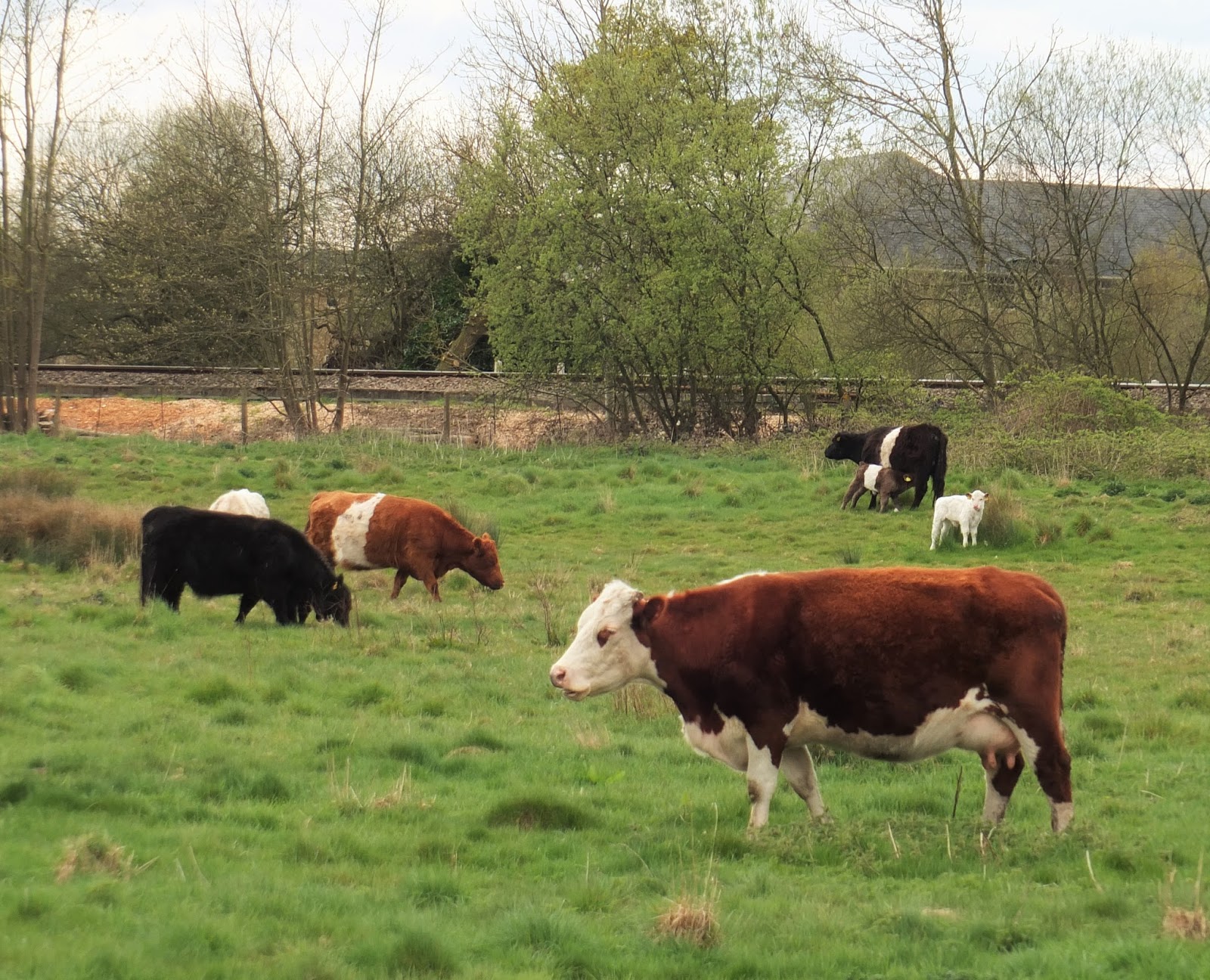
Another new addition to the patch recently have been the cows which appeared in St Catherine's Meadow and up in the Old Watermeadows near Guildford on the 24th. Cattle Egret anyone?
Cows!
Lapwings were recorded flying north-east twice last weekend - two on the 23rd and one on the 24th - only my second and third patch records of this species this year, surprisingly.
Skylarks have been rather more evident recently, with one heard singing well west of Horse Field early on the 26th, 28th and 29th, and two which flew up from St Catherine's Meadow on 1st May. I know they breed up on the hills to the north-east and would imagine they're present at Loseley Park to the west, but suspect there is insufficient breeding habitat for them around the water meadows here.
On 1st May I was surprised to stumble across a Firecrest along the Railway Line Walk - my first record of the species here for a number of weeks and seemingly an odd time for one to turn up, although Martin Kettell had one at Stoke Water Meadows just yesterday. A nice end to a good couple of weeks which has taken my Patchwork Challenge total to 95 species/101 points. I'm looking forward to seeing what May has in store!
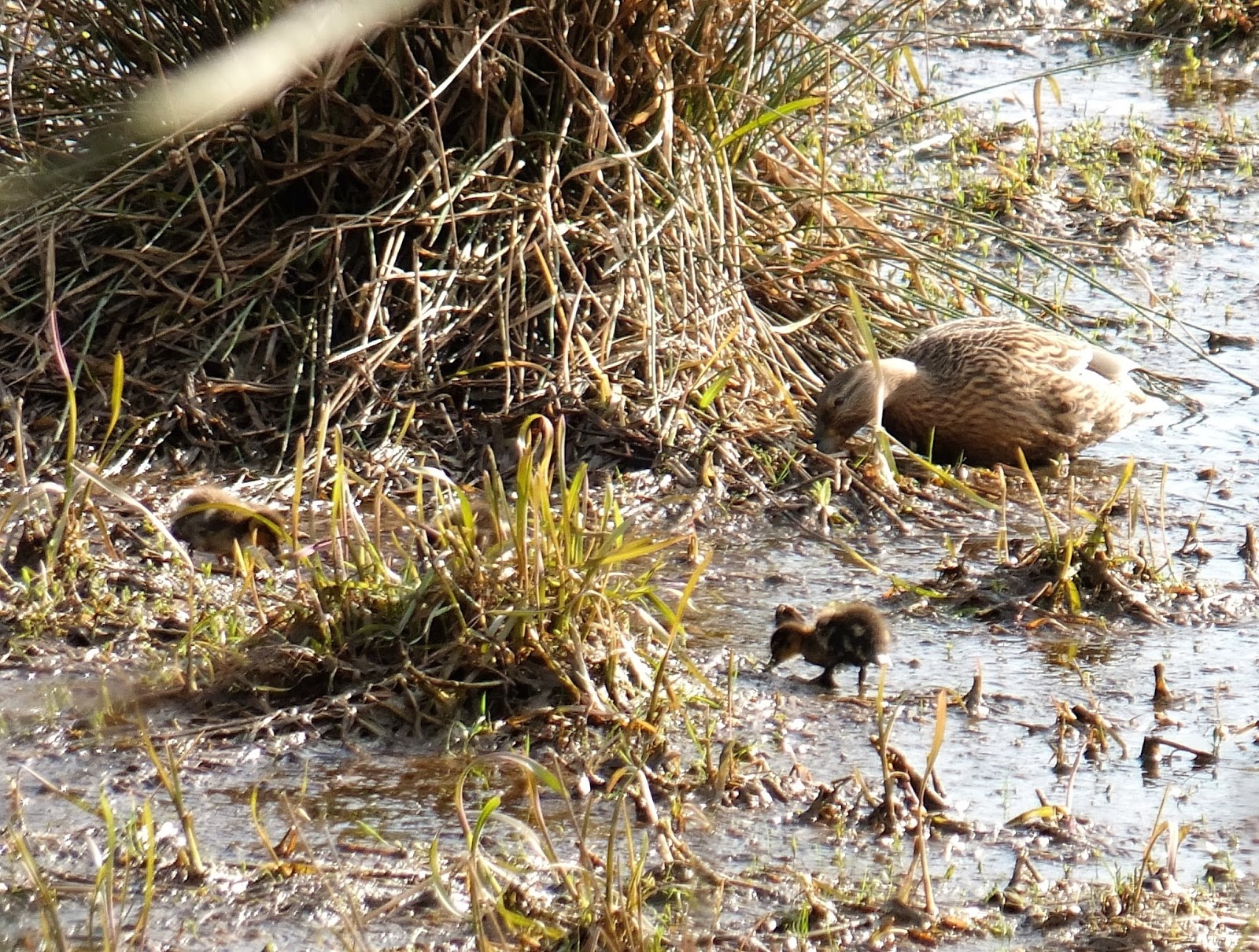
An after work visit to the patch produced at least six Chiffchaffs, one Blackcap and three Swallows on the migrant front, while the first Mallard ducklings of the year were out on Broadford Marsh. Other wildfowl were represented by at least twenty-nine Teal, half a dozen Shoveler and two Mandarin while the drake Gadwall was still present on St Catherine's Pool. Of note overhead were three Lesser Black-backed Gulls north and two Red Kites north-west together.
First ducklings of the year
Tuesday 5th April
A quick early morning dash round the patch before work again produced a handful of Chiffchaffs and Blackcaps, while wildfowl numbers were considerably lower than yesterday evening with just three each of Shoveler and Teal and two Mandarin of note. The two Little Owls were in their usual tree while noteworthy flyovers were two Greylag Geese south and a Skylark east.
Wednesday 6th April
An evening circuit of the patch after a day of showers. Of note were singles of Mandarin and Gadwall, a pair of Shoveler and nine Teal. Out in the horse field there were at least ten Pied Wagtails and three Fieldfare which may prove to be my last of the season. Pretty much the last bird of this evening's visit was a Peregrine flying over Broom Meadow.
Gadwall
Thursday 7th April
It had been another typical showery April day when I headed to the patch after work, and I hadn't walked far before the heavens opened again for a more persistent spell of rain which soaked me to the bone during my two hour visit. Wildfowl numbers are definitely dropping now, with just two pairs each of Teal and Shoveler around the place. The smaller birds were in fine voice despite the weather, including at least one Willow Warbler, and an unexpected Redstart (88) which sang briefly near the Riff Raff weir during another heavy burst of rain before disappearing behind a thick hedge where it called for a while then went silent. There were an impressive seventeen Pied Wags out in the horse field, while Broom Meadow harboured at least ten Linnets. Signs of movement overhead came in the form of two House Martins, two Grey Wagtails and a single Swallow, all heading north.
Saturday 9th April
An extended morning visit which again saw me dodging the showers. Overnight rain had clearly brought with it an increase in Blackcaps as there were at least six singing males around and an obvious pair flitting around together in the Broadford area. It was down this end of the patch I also found the first Carrion Crow nest of the year, plus a singing Willow Warbler.
Carrion Crow nest
Hirundine numbers are also on the up, with at least eight Sand Martins, six Swallows and two House Martins through during my visit, plus others too high to be identified with confidence.
Sand Martin
The drake Gadwall was again on St Catherine's Pool, but the only other wildfowl of note were three Mandarin. Raptors were up and enjoying the sunshine mid-morning, with at least ten Buzzards in and around patch airspace, two Kestrels and three Sparrowhawks, including a pair displaying. The Little Owl was also in its usual tree.
Richard Waters visited later and had nine Greylag Geese fly over.
Greylag Geese - Richard Waters
In the afternoon I took a stroll up nearby Pewley Down, hoping to finally catch up with a local Wheatear, but found just a single Yellowhammer of note.
Sunday 10th April
An early and frosty start for a dawn visit to my workplace Winkworth Arboretum (for the montly WeBS count) and nearby Thorncombe Street where I found three lingering Brambling up on 'The Ridge' and also heard my first Cuckoo of the year.
Another first for the year came on the patch a little while later with the familiar scratchy warble of a Whitethroat coming from an Elder bush by the railway line. Increasingly one of the most numerous warblers in Surrey, always great to see them return.
First Whitethroat of 2016 (honest!)
There were also at least six Blackcaps singing again and nine Chiffchaffs, including one pair already busy nest building near St Catherine's Pool. The Little Owl was again present as were at least two of the resident Kestrels (I think there are two pairs here now), while flyover highlights were a heard only Redpoll and two House Martins west.
Monday 11th April
A late afternoon visit today produced at least two Whitethroats singing along with the usual scattering of Chiffchaffs and Blackcaps. Wildfowl were represented by six Teal, one Shoveler and a pair of Mandarin while there were at least six Buzzards and a Sparrowhawk up in the sky, along with two Red Kites which flew north-west together, as they did on the 4th, but this time they later came back the same way, again flying in tandem.
Mandarins
It was good to meet fellow local bird Tim Staton who is a regular at Shalford - I'm not sure how it's taken me four months of patch watching the area to bump into him! We had a good chat about the area and other local birding highlights. As we were chatting four House Martins flew north.
Later on in the evening lengthsman Rob Craig reported a Little Egret.
Tuesday 12th April
An extended daytime visit to the patch after an early start for my first WBBS visit of the year to the river at Papercourt Water Meadows near Woking, which had given me my first Sedge Warbler of the year, plus singing Cuckoo and a Water Rail in flight along the river.
It was already a gloriously warm and sunny morning by the time I got to Shalford and the whole place was ringing with birdsong. Warbler numbers were particularly impressive, with at least twenty-three Chiffchaffs, fourteen Blackcaps, one Whitethroat and seven Willow Warblers across the recording area. The latter is particularly notable for a species which is increasingly a mere passage migrant in swathes of Surrey now.
The Chiffchaffs are now clearly pairing up fast and I watched several prospecting nest sites today. Raptors too were enjoying the spring weather with at least ten Buzzards airborne along with three Sparrowhawks, two Kestrels and two Red Kites. A Raven also drifted over very high going south-west mid-afternoon.
Raven (I did say it was high!)
Other signs of spring included two Mallard ducklings following a female along the navigation and Magpies gathering nesting material. Hirundines were represented by one House Martin, two Swallow and five Sand Martin. Other highlights from today were five Mandarin and three Little Grebes on St Catherine's Pool and the usual Little Owl pair again in their tree. It was also clearly an excellent day for butterflies as I saw my first Orange-tip, Holly Blue and Speckled Wood of 2016 along with at least ten Small Tortoiseshell, nine Brimstone and six Peacock.
Wednesday 13th April
Another largely fine day with just the odd shower and I again headed down to the water meadows after work. Plenty of warbler song again, with at least eleven Chiffchaffs and four Blackcaps. On St Catherine's Pool I found two Little Grebes and the drake Gadwall still present, while there a dozen very young Mallard ducklings on the navigation by St Catherine's Lock, including three pure yellow ones! Flyover highlights from this evening's visit were Sparrowhawk, a Red Kite east, one Swallow and a House Martin east.
One of the bright yellow ducklings at St Catherine's Lock
Thursday 14th April
After an absolutely stonking six hour Leith Hill tower migration watch this morning I wasn't expecting too much from my afternoon visit to Shalford - you can't expect fireworks all the time, especially when it comes to birding in Surrey.
The weather was also on the turn and rain was clearly on the way when I arrived at the patch.
Still, I again found the place alive with singing warblers; at least ten each of Chiffchaff and Blackcap and a single Whitethroat.
Storm clouds gathering over St Catherine's Lock
The last of the sunshine meant there were still several raptors up and about: at least two each of Buzzard, Sparrowhawk and Kestrel seen during my visit plus a single Red Kite west. Water birds were rather thin on the ground, or water, with just the lingering drake Gadwall, one Little Grebe and three Mandarin of note.
Overhead a couple of Swallows and House Martins passed through, while the butterflies were again out in force, with at least four each of Peacock and Small Tortoiseshell and singles of Comma and Brimstone seen.
Friday 15th April
A decent three hour visit to the patch this morning (I had a few days off this week in between finishing at Winkworth and starting my new job on the 18th) which produced 53 species. First up was an unexpected patch tick on one of the Broadford pools: a Great Crested Grebe (91) - not only my first record of one in the Chilworth/Albury/Shalford area in two years of living locally, but also the first time Rob Craig has heard of one here in all his time as lengthsman. There was also a trio of Tufted Duck in the same area; only my second record of this species at Shalford this year.
Warbler numbers were again good, with at least thirteen Chiffchaffs, six Blackcaps and four Whitethroats around. Out in the horse field Pied Wagtails were gathering nesting material while in Bog Meadow a pair of Reed Buntings were frequenting a bramble patch. Gull numbers have dropped right down in the past two or three weeks, so two Lesser Black-backed Gulls north-east were noteworthy. Hirundines were again trickling through with at least three Swallows and nine House Martins north, while two Sand Martins bucked the trend and flew south!
Saturday 16th April
Another three hour patch stint from dawn this morning produced 55 species. The Great Crested Grebe was still present in the Broadford area, as was a singing Willow Warbler - the first one for a few days. Other warblers were represented by at least eleven Blackcaps, nine Chiffchaffs and four Whitethroats. There was a fair amount of movement going on overhead, with five Greylags south-west, three Lesser Black-backed Gulls, two Herring Gulls andthe first Black-headed Gull for a while plus seven Swallows north. There were an impressive four Sparrowhawks in the air together at one point, all displaying and having a bit of a dogfight over Broadford - quite impressive to watch!
There were still a couple of Teal around in addition to two Mandarin, three Grey Herons and a Little Grebe.
Sunday 17th April
A morning spent surveying on the Ash Ranges produced my first Tree Pipits of the year, plus good numbers of Redstarts, Dartford Warblers, a trio of Woodlarks, a couple of Swallows and a flyover Cuckoo. In the afternoon my girlfriend and I paid a visit to our Shalford allotment where we had a single Swallow flying and singing low overhead as we dug, plus a flyover Redpoll.
It was only a brief visit to the patch this evening then, after all that, with again no new additions to the year list. It was nice to see half a dozen or so House Martins seemingly lingering over the village though, rather than just racing through, unlike the single Sand Martin which zoomed north low over Broom Meadow.
Never noticed this sign before - anyone fancy a long stroll?