Aside from two trips to South Africa I've done very little birding abroad, so when my girlfriend and I decided to book a few days in Sardinia to use some of the air miles we'd accrued from our SA trips I was excited to see what new birds we might encounter.
We flew into Cagliari at lunchtime on Tuesday and headed to Hotel Chentu Lunas in Poetto where our wonderfully friendly host Graziella had arranged for hire bicycles to be dropped off. We hopped on and headed along the beachfront to the Parco di Molentargius; a Ramsar protected site and one of several large wetlands on the outskirts of the island's capital city. En route we saw and heard the ubiquitous Hooded Crows, Serins, Spanish Sparrows, Tree Sparrows and Spotless Starlings in the beachfront gardens.
Tree Sparrow on a lamppost! A common sight in Poetto
We had seen Greater Flamingoes from the plane as we came into land so it was no surprise to see lots of them as we entered the park. I knew Sardinia has a healthy population of this species but was still amazed to see so many: every body of water was covered in them, interspersed with smaller numbers of Avocets, Black-winged Stilts, Shelduck and Pochard. There were several Terns flying about, including singles of Gull-billed Tern and Little Tern plus a few Common Terns, while among the numerous Yellow-legged Gulls it was nice to pick out a couple of Slender-billed Gulls.
Greater Flamingo
Slender-billed Gull
Gull-billed Tern
In the vegetation around the park Reed Warblers and Cetti's Warblers were very vocal, while the scrubbier fields and hedges held Collared Doves, Spotless Starlings, Zitting Cisticolas and Sardinian Warblers. At one point we flushed a Cattle Egret as we cycled past and later a Purple Heron which flew off into one of the massive reedbeds. As we headed back past the biggest pool near the main entrance a Squacco Heron gave a nice flypast. Overhead there were large numbers of both Common Swift and Pallid Swift plus Barn Swallows, House Martins and Sand Martins; so numerous their combined calls provided a constant soundtrack to our time here. As we parked up our bikes to check out one of the tower hides a familiar call alerted me to two Bee-eaters amongst the hirundine flock above us. Around the same time Kate pointed out a Crimson Speckled moth on the ground which unfortunately proved too flighty to allow good views or a photo. Molentargius is up there with West Coast National Park in South Africa as one of the best nature reserves I've visited; I wish we could have stayed for longer.
Cattle Egret
Spotless Starling - strangely the only photo I got of this common species
Sardinian Warbler - this male was busy collecting food and taking it back to a nest
The next morning (Kate's birthday) we woke to the sound of singing Serins and Greenfinches and a quick scan from the balcony produced a Peregrine flying in front of the mountain and scores of House Martins and Swifts over the water and buildings behind the hotel. After breakfast at one of the beachfront cafes we hit the road for the three hour drive up to Dorgali in the mountains up the east coast. The drive was incredible and slightly terrifying at times as we wound our way along mountain passes in an unfamiliar car on the other side of the road! There was plenty of bird interest along the way including several Turtle Doves and two Monk Parakeets flying across the road and perched on wires, a Bee-eater hawking near the road, Crag Martins nesting under a road bridge and the first of several high altitude raptors which at the time suggested Honey Buzzard but was later identified from my photos by others as a Marsh Harrier.
By mid-afternoon we'd made it to Agriturismo Canales - a charming traditional farmhouse set on a hill by the edge of Lake Cedrino and with great views across into Gennargentu National Park - our home for the next two nights. The first thing that struck us here was the overwhelming quietness of the setting, interrupted only occasionally by goat and sheep bells and bleats, and bursts of song from Turtle Doves and Cirl Buntings. We also found our first Spotted Flycatcher of the holiday squeaking away near our chalet here. It's a cliché to say it but it really is striking how these scarcer species still seem to be thriving further south in Europe, presumably due in no small part to the more sensitive way in which the land is managed; for the time being at least, intensive agriculture with its flailed hedges and monocrops sprayed within an inch of their life are nowhere to be found on Sardinia, or not that we saw anyway. It's a sobering glimpse of a landscape that is becoming such a distant memory in much of Britain.
Cirl Bunting
Turtle Doves
As night began to fall the valley below our chalet really came to life as the first Robins, Wrens and Blackcaps we'd heard during the trip, amongst others, burst into song. After dinner we returned to our balcony to the distinctive sound of Scops Owls duetting and a curious call which I soon discovered to be Barbary Partridge. I regularly heard them calling quite close to our chalet during our stay here and spent a good couple of hours or more in total trying to track them down but sadly they remained frustratingly elusive!
After a hearty breakfast on Thursday morning we drove down to Baunei as Kate had suggested we try the walk from the Golgo Plateau down to Cala Goloritzé – a picturesque beach only accessible by boat or by hike, and reputedly a good site for Eleonora's Falcon. No sooner had we got out of the car at the Golgo Plateau than one drifted overhead; a good start! The hike down took us through deeper and deeper vegetation, soundtracked almost constantly by Firecrests and occasional Sardinian Warblers. At one point I heard a Dartford Warbler calling as well.
A little clearing halfway down dotted with Holm Oaks produced at least two Spotted Flycatchers, a Pied Flycatcher and a Wood Warbler while our second Eleonora's Falcon powered overhead. Nearer the beach we saw Crag Martins and Alpine Swifts flying around the cliffs while down at the beach itself a couple of Ravens and another Peregrine flew over along with another high altitude broad-winged raptor which I judged to be a Honey Buzzard from its shape and 'whole wing' wingbeats.
Spotted Flycatcher
Pied Flycatcher - sadly the only picture I got as it wouldn't stop moving!
The hike back up proved challenging and during one of several hard-earned rest stops we were rewarded with a little group of Corsican Finches flitting about in the bushes quite near the path in the aforementioned area which I nicknamed 'Flycatcher Corner'.
Corsican Finch
Overhead a couple of soaring Common Buzzards were joined by another Marsh Harrier which drifted east, as did another Eleonora's Falcon. On the way back to the main road we were drawn to stop by a gathering of pigs and donkeys on the dirt track ahead and it was here we heard our only Cuckoo of the holiday.
Back at Canales we had dinner on the balcony again to the sound of Scops Owls and Barbary Partridge plus a brief burst of churring from a Nightjar.
Our fourth day in Sardinia saw us again on the road for a long drive down to the south-west - Portovesme to be precise - from where we caught a ferry over to Isola di San Pietro. Though this holiday was primarily about having a few days away for Kate's birthday I made a special request that we go and see the Eleonora's Falcon colony on the island. I wasn't sure they'd be back on territory yet but having seen three the previous day my confidence was bolstered. The ferry over to the island proved productive with two Scopoli's Shearwaters flying past, one very close, plus two flyover Little Egrets, several Shags and two Black-headed Gulls: the only time we saw this species during the whole trip.
After making shore and indulging in a bit of tapas we headed over to the west side of the island and the LIPU reserve at Faro di Cala Sandalo, the most westerly point of Italy and home to the Eleonora's Falcon colony. As soon as we'd got out of the car I spotted a couple of them sailing about over the cliffs. A friendly chap showed us a mouthwatering photo of one of the birds he'd seen earlier perched on a crag and pointed us in the right direction. Within a few minutes we were sat on the cliff edge watching in awe as at least four of these magnificent birds - both pale and dark morphs - put on an incredible display right in front of us, sometimes cruising about amongst the gulls and Alpine Swifts, at other times dashing and diving at breakneck speed towards the ocean before veering back up, almost looping back over on themselves, calling excitedly as they did so. Breathtaking. Sometimes in life and in birding you sense that a moment will live with you forever. To top it all off Kate spotted a dark morph individual that had just alighted on the cliff less than 50 metres below us. Magical.
I could have stayed there for hours but unfortunately we were rather short of time as we had to catch the ferry back to the mainland and check in to our B&B in Portoscuso. A quick check of one of the stagni (saltwater lagoons) near Carloforte on the way back produced more Greater Flamingoes, Avocets and Black-winged Stilts, lots of Little Egrets, a single Grey Heron (our only one of the trip!), a couple of Slender-billed Gulls and Common Terns and a very vocal Zitting Cisticola carrying food.
Black-winged Stilt
Saturday was our final morning in Sardinia so I couldn't resist a little seawatch from our hotel window before we packed up our bags, hoping I'd be able to pick out a distant seabird or two. I was pleasantly surprised to find not just one but at least four Scopoli's Shearwaters almost straight away, feeding quite close in to the shore. After watching them for a while a smaller and more strongly contrasting black and white bird darted across my scope view: a Yelkouan Shearwater! One of two seen during this session and a very nice way to end our time here in Portoscuso.
Soon we were on our way back to the airport but the birding fun wasn't quite over as a couple of rest breaks and a petrol stop added Corn Bunting and Skylark to the holiday list, singing in the fields near the road, while birding from the car* produced another Bee-eater and two Black Kites over one of the recently cut hay meadows. If we ever come back here I'd definitely like to spend a bit more time exploring the more agricultural areas of the island as I suspect there were many avian treats hiding there. The very last bird of the holiday was a Marsh Harrier quartering over the reeds that separated the airport tarmac from the Stagno di Cagliari beyond.
It wasn't all about the birds of course. We saw a great many butterflies during our trip, particularly Clouded Yellows, but also Red Admiral, Painted Lady, Brimstone, Cleopatra, various Whites and a Small Copper. Most were too flighty to photograph, sadly, but I did manage to capture a shot of one on the walk back from Cala Goloritzé which I didn't recognise. Looking in my Collins guide when we got home I realised this was a Corsican Wall Brown which is endemic to this part of the world.
Corsican Wall Brown
Everywhere we went, particularly in the Gennargentu area and on Isola di San Pietro we saw lizards, most of which I think were Tyrrhenian Wall Lizard, like the one pictured below which scuttled across our balcony at Canales.
All in all a great few days in a wonderful part of the world. There's really far too much to see in four days though - I hope to return one day and it's certainly inspired me to do more European birding!
* If you're looking to hire a car while in Sardinia, I must just implore you not to go anywhere near Avis, they are absolute crooks who swindled us out of £300 for the tiniest of chips on the rear spoiler which any respectable hire company would have overlooked as general wear and tear. Worst customer service I've ever experienced in years of hiring cars. Avoid!
It was a few weeks ago while driving home from an excellent day's birding in Hampshire and Wiltshire that Ed Stubbs and I hatched a plan for an extended day trip to Cornwall in August, primarily to take in some of the great seawatching on offer at Porthgwarra at this time of year. As weeks went by Ed put together a mouthwatering itinerary which saw us, along with friend and Surrey birding legend Robin Stride, aiming to catch up with a very tasty and more than a little ambitious selection of target species.
So it was that we set off from Surrey at around 3pm on Friday 5th, with a view to reaching the far end of the Cornish peninsula before sunset, ready to start bright and early at Porthgwarra the following morning. En route we discussed potentially getting in a bit of seawatching that evening or perhaps stopping at Black Hole Marsh to twitch the Least Sandpiper. Sadly the latter bird wasn't reported throughout the day but our spirits weren't dampened, even when we ran in to the inevitable holiday/Friday evening traffic around Stonehenge. Unfortunately my car had other ideas and started to splutter and lose power a few miles later, and after a few phonecalls we were being chaffeur-driven back to Surrey by recovery man Fred, my poor old Focus strapped on the back of the lorry. We weren't about to let that stop us though.
I asked Robin what the plan was now, as the sun began to go down and we got further and further away from Cornwall. He replied "we're going to Cornwall." Legend. Back in Godalming we quickly loaded in to Robin's car and set off, by now in darkness, but at least the roads were far quieter. We made good time and were approaching Porthgwarra a little after 2.30am, almost twelve hours after we originally set off. Certainly not the quickest journey to Cornwall but at least we got there - thanks to Robin! We pulled up by the roadside to catch a couple of hours sleep (well some of us - sorry Ed!) and then it was on with the adventure.
Despite my dressing up for Arctic conditions - I've done more than enough seawatching to know it can be a hypothermia-inducing pastime even in summer - we parked up by the cafe in Porthgwarra to find it remarkably calm and warm. Visibility was good from the seawatching point and there were already half a dozen or so birders present when we arrived at around 6am. We'd barely sat down before the first shout went up: 'Balearic Shearwater, close in!'. One of at least seven we had during our three hour stint here, and the best views I've had to date of this species. Manxies were streaming past almost constantly, interspersed with four Sooty Shearwaters, also giving better views in the calm conditions than I'd had in Britain before. The relatively flat sea and good light also afforded us lovely views of at least twenty Storm Petrels which passed by during our visit, many powering on west but some lingering and feeding near the Runnel Stone and gathered fishing boats. Other highlights from what ended up being one of my most enjoyable seawatches included a summer plumage Great Northern Diver which flew overland behind us, a single Whimbrel, and two Chough - a UK lifer for Ed.
By 9am things had gone a bit quiet so, after a quick coffee and a pasty (when in Rome), we hit the road again, heading to Perranuthnoe hoping to catch up with the long-staying Hudsonian Whimbrel. On arrival we met a birder who said he'd just had it in the next cove then watched it fly off west into the next cove along. It was getting a bit wet and windy at this point and we had a few frustrating minutes scouring the rocky coastline with just a single Eurasian Whimbrel and twenty or so roosting Curlew to show for it. A slight change in position though revealed more Whimbrel hidden amongst the Curlew - one with strikingly bold headstripes... We deliberated for a short while and then the bird took flight revealing a complete absence of white on its back - bingo!
No pictures of the Whimbrel unfortunately, but it was nice to see Rock Samphire and Restharrow along the coastal path.
Our next target bird was the Dalmatian Pelican. If accepted as a wild bird this would be Robin's 500th UK bird so the pressure was on! Ed fed us reports from BirdGuides as we drove. Apparently it had flown west from Restronguet a short while ago so we had an idea to pre-empt it and went to check out Hayle Estuary, another of the bird's favourite haunts. There was no sign of it when we got there but it was nice to be back at a place I've enjoyed birding several times in the past and to add a few common species to the day list. Just as we were about to walk up the road from the Old Quay House pub to get a better view of the estuary another report came in - the Pelican was back at Restronguet! Restronguet Creek is a beautiful part of the country, and reminded me a lot of South Africa.
We had no idea exactly where we were looking though, aside from an island somewhere in the creek south-east of Devoran. After an extended session on foot without reward a local pointed us in the right direction and we drove a little way east along the creek where we found the Pelican sitting on an island, as promised. I've seen Great White Pelican in Africa but this bird really looked huge. Something like a giant swan with the head of a Spoonbill, and then that ludicrous yellow bill. It hardly moved for the whole hour or so we watched it, aside from the odd stretch, scratch and look around.
After a well-deserved celebratory pint in the local pub we bid Cornwall farewell and continued on our way with around six hours of daylight remaining and three target birds left to see. Robin knew a few spots along the River Dart which he said were good for Dipper and, sure enough, at the second attempt we enjoyed close views of one. Only a year tick for us all but always a lovely bird to see.
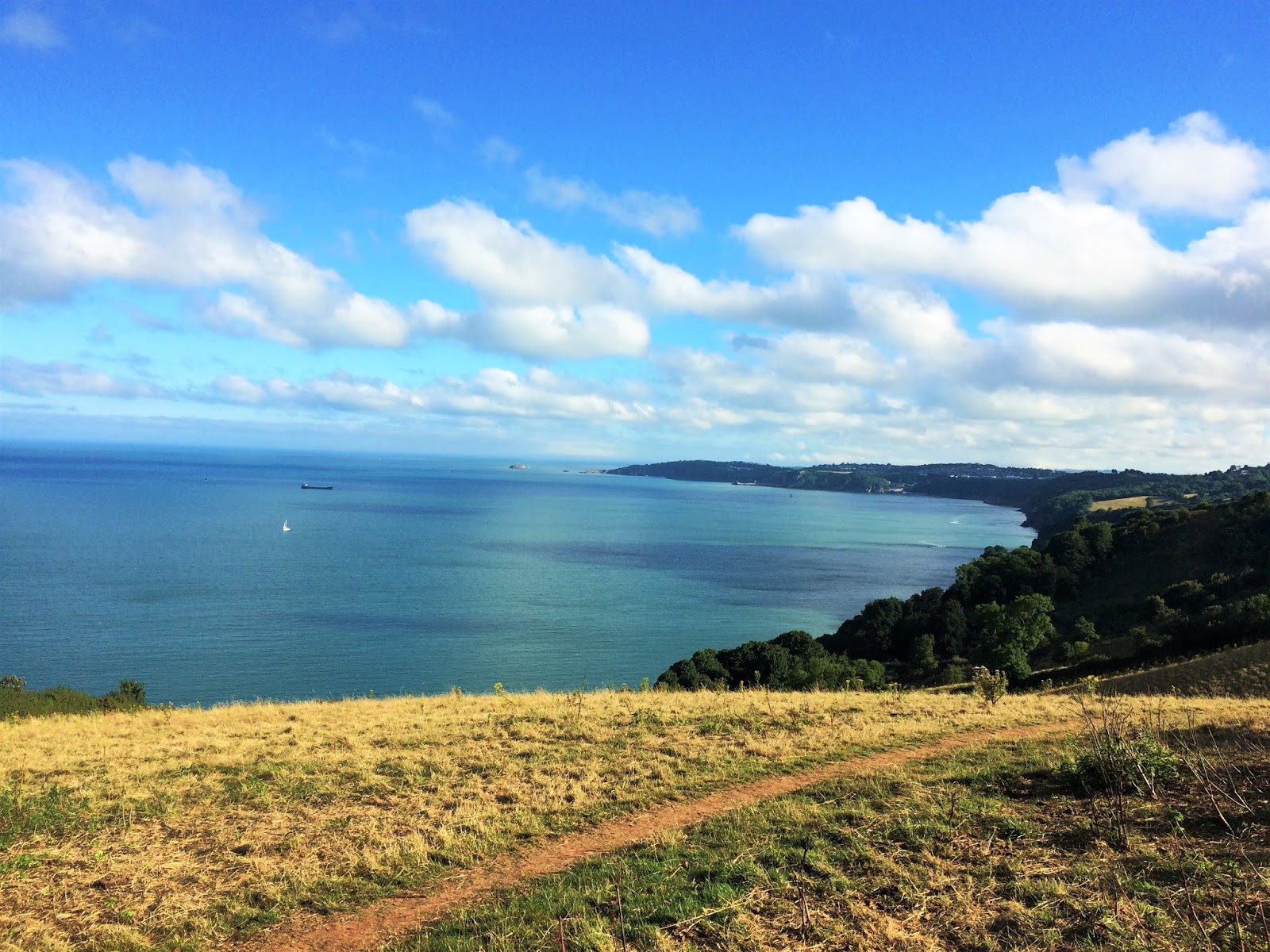
Next on the agenda was Labrador Bay for Cirl Bunting - a long-overdue lifer for me. I was blown away by the beauty of the place, the golden fields bathed in the late afternoon August sun against a backdrop of azure sky and sea.
We didn't have to venture far from the car park before a male Cirl Bunting flew over our heads and very obligingly perched in the hedge in front of us for a few seconds before flying deeper into the vegetation. Soon it flew back out, joined by a female, and both birds gave close views before disappearing into the sacrificial crop field. Before long they were back out again, both carrying food - clearly they have a second brood of hungry young to feed.
On the road again and just a couple of hours left to find our final target bird of the trip - the summer plumage Spotted Sandpiper that turned up at Sutton Bingham Reservoir near Yeovil during the week. After some very welcome directions from Sean Foote and Tim Farr via Twitter we found ourselves looking across at the fishing lodge area of the reservoir from the road that cuts through the northern section. The light was really fading now but by chance a small dark wader flew across my scope view and disappeared round the corner. We realised we had to get over by the fishing lodge, and after a few frantic minutes in the car we were there, now with just minutes of usable daylight left. A quick scan of all visible areas of sandy shoreline ensued before I spotted it (no pun intended) in the far corner. A stonking bird to end a stonking trip. As a Kingfisher piped its way across the reservoir and the last of the daylight waned away we climbed back into the car, exhausted but happy, and headed home for some very welcome sleep. Thanks to Ed and Robin for the company, the birds and the banter. Roll on the next trip!


 A little clearing halfway down dotted with Holm Oaks produced at least two Spotted Flycatchers, a Pied Flycatcher and a Wood Warbler while our second Eleonora's Falcon powered overhead. Nearer the beach we saw Crag Martins and Alpine Swifts flying around the cliffs while down at the beach itself a couple of Ravens and another Peregrine flew over along with another high altitude broad-winged raptor which I judged to be a Honey Buzzard from its shape and 'whole wing' wingbeats.